

If you’re applying for a green card and have medical records in a language other than English, you must provide accurate English translations to avoid delays or rejections. USCIS requires translations to include a signed certification verifying their accuracy. Mistakes, even small ones, can delay applications by 60–90 days.
Key points:
- What to translate: Vaccination records, hospital summaries, lab results, and physician letters.
- Translation rules: Every word must be translated (no summaries), and each document needs its own certification.
- Certification requirements: Translator’s name, signature, date, contact info, and a statement of fluency and accuracy.
- Avoid common errors: Incorrect date formats, missing stamps/seals, or incomplete translations.
Starting December 2, 2024, Form I-693 must be submitted with Form I-485, making early preparation of translations critical. Proper organization, high-quality scans, and choosing skilled translators familiar with medical terminology can save time and prevent issues.
Getting certified document translation for USCIS
sbb-itb-00cb036
USCIS Translation Requirements Explained
USCIS translation rules, outlined in 8 CFR 103.2(b), require that all foreign-language documents submitted must include a complete English translation along with a signed certification from the translator confirming its accuracy. Every word must be translated – no summaries or omissions are allowed – or you risk receiving a Request for Evidence (RFE), which can delay your case by 3–6 months. Additionally, each document must have its own certification; a single certification for multiple documents is not accepted. Below, we’ll cover which medical records need translation and the specific details they should include.
Which Medical Documents Need Translation?
Not all documents from your doctor require translation, but USCIS typically asks for English translations of the following:
| Medical Document | Purpose |
|---|---|
| Vaccination Records/Booklets | Confirms compliance with vaccine requirements for Form I-693 |
| Hospital Discharge Summaries | Provides medical history for civil surgeons or asylum applications |
| Lab Results/Titers | Demonstrates immunity if vaccination records are unavailable |
| Physician Letters/Referrals | Helps civil surgeons understand prior conditions or ongoing treatments |
| Psychiatric Evaluations | Needed for asylum cases or N-648 disability waiver applications |
Vaccination booklets often contain handwritten notes, vaccine lot numbers, and faint stamps, all of which must be fully translated. If parts of the document are unreadable, label them as "[illegible]" rather than guessing.
Now that you know which documents to translate, it’s crucial to understand the translator’s role and certification requirements.
Translator Certification and Qualifications
Accurate translations start with a skilled translator. USCIS does not require translators to have official licensing or ATA certification. According to 8 CFR 103.2(b), anyone fluent in both the foreign language and English can translate documents, as long as they provide a signed certification. This certification must include the translator’s full name, signature, date, contact information, and a statement attesting to their fluency and the accuracy of the translation.
Here’s an example of a commonly accepted certification statement:
"I, [name], certify that I am fluent in [foreign language] and English, and that I am competent to translate from [foreign language] into English. I certify the attached translation is complete and accurate."
Notarization is not required. A notary only verifies the translator’s identity, not the accuracy of the translation.
While anyone fluent in both languages can translate, self-translations or using a family member is discouraged. These scenarios could create conflicts of interest and may lead to rejection. For medical records, it’s especially helpful to work with translators familiar with medical terminology, including vaccine lot numbers, dosage units, and diagnostic abbreviations. This expertise reduces the chances of errors and avoids unnecessary delays.
"The real goal is first-pass acceptance by USCIS, your civil surgeon, or your insurance reviewer. In most failed submissions I see, the problem is… weak certification wording, or formatting that makes review harder than it should be." – Erin Chen, Co-Founder and Translation Strategist, CertOf™
How to Prepare Medical Records for Translation
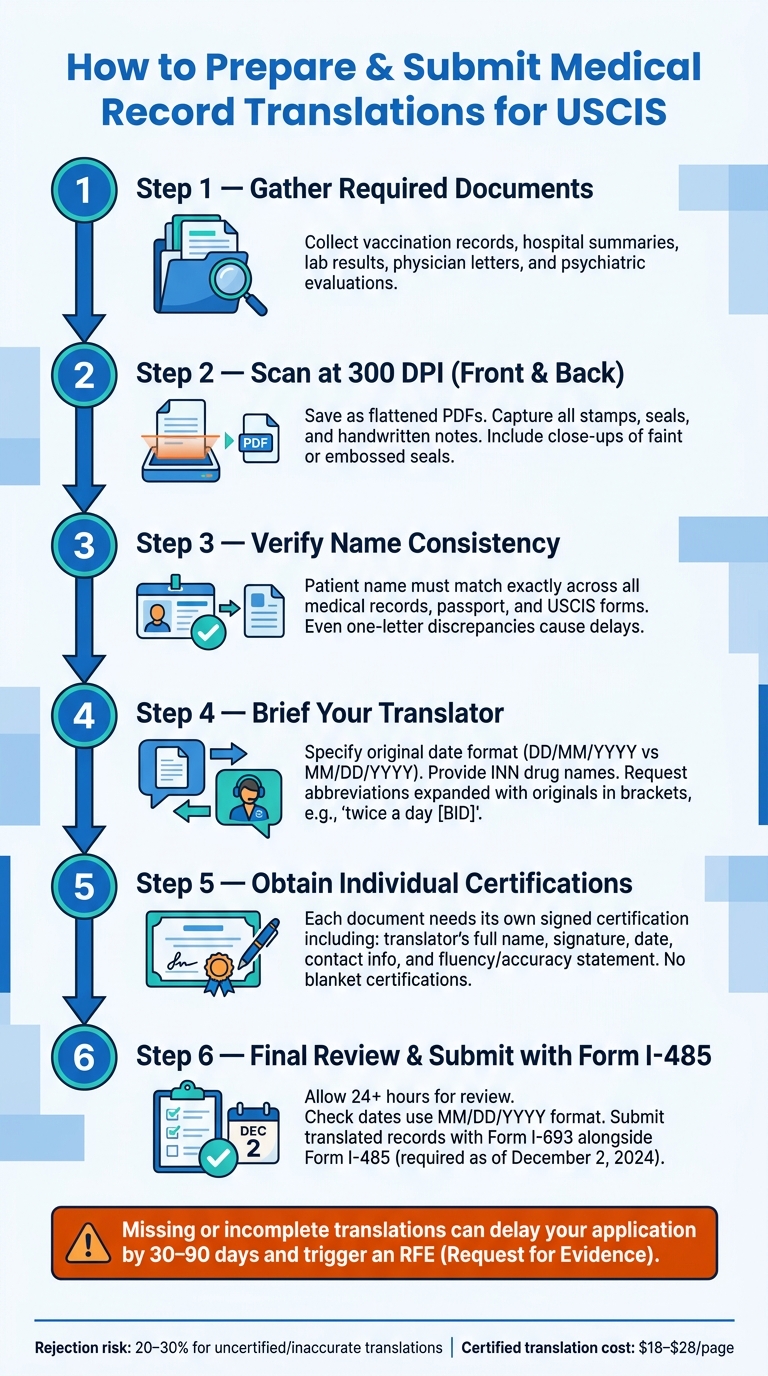
USCIS Medical Record Translation: Step-by-Step Submission Checklist
Preparing your medical records properly before sending them to a translator can save you a lot of time and prevent unnecessary delays. According to data, around 12% of applicants face delays due to documentation errors.
Organizing Your Medical Records
The first step is to scan every page of your documents at a resolution of at least 300 DPI and save them as flattened PDFs. This is important because USCIS uses OCR (optical character recognition) technology to process documents. Low-quality scans can result in an "unreadable" rejection. Make sure to scan both the front and back of every page to capture stamps, signatures, and registry details.
Next, double-check that the patient’s name matches exactly across all documents, including your medical records, passport, and USCIS forms. Even minor discrepancies, like a single letter being off, can lead to additional reviews. Also, remember that each document needs its own certification statement.
| Preparation Step | Why It Matters |
|---|---|
| 300 DPI scanning | Ensures documents are readable and compatible with OCR technology |
| Front and back coverage | Captures legal details like stamps and registry entries on the reverse |
| Name consistency check | Avoids delays caused by name mismatches across documents |
| Individual certification | USCIS requires a separate certification for each document |
Once your records are properly scanned and organized, include additional context for technical details to help ensure accurate translation.
Helping Translators Understand Medical Terms
After organizing your records, clear communication with your translator becomes essential. One common issue involves date formats. Many countries use DD/MM/YYYY, while the U.S. follows MM/DD/YYYY. Be sure to specify the original date format to avoid errors in interpreting vaccination dates or treatment schedules.
For medications, provide the International Nonproprietary Name (INN) or the U.S. equivalent if no direct English translation exists. Additionally, ask your translator to expand all medical abbreviations into English while keeping the original abbreviation in brackets. For example, "twice a day [BID]" maintains traceability.
"Medical translation is not paraphrasing. Abbreviations are expanded with source abbreviation in brackets, lab units stay unchanged, and dosage lines are never rounded." – Sarah Jenkins, Medical and Compliance Translation Specialist, CertTranslate
If your documents include faint stamps, embossed seals, or handwritten notes, include high-resolution close-up images in your scans. Translators are required to describe official seals in their work, even if the text on them is illegible. For example, a seal might be noted as [Round Seal: Civil Registry] in the translation. Omitting these details could render the translation incomplete in the eyes of USCIS.
How to Choose a Qualified Medical Translator
Once you’ve organized your medical records and briefed your translator, the next step is finding someone with the right expertise to handle your documents. Selecting a translator experienced in medical translations ensures your documents meet USCIS standards. Let’s break down what to look for when choosing a translator.
What to Look for in a Medical Translator
Although USCIS doesn’t provide an official list of approved translators, the legal requirement is straightforward. According to 8 CFR 103.2(b), every translation must include a signed certification attesting to its accuracy and completeness. Make sure the translator provides an individual certification for each document. This certification should explicitly affirm their competency and the accuracy of the translation. If it doesn’t, that’s a warning sign.
Experience with medical documents is critical. Translators familiar with materials like lab results, WHO vaccination cards, or psychiatric evaluations are more likely to catch important details that others might overlook. Membership in the American Translators Association (ATA) is another good indicator of professionalism. Native speakers of the source language are often preferred because they better understand the nuances and context of medical terminology. Additionally, ensure the translator offers free revisions, as USCIS might flag issues like incorrect name spellings or date formats.
"A translator who is excellent at legal or commercial work but lacks a medical background may produce a translation that is linguistically accurate but terminologically incorrect." – ASAP Translate
Being aware of common translation mistakes is just as important as choosing the right translator. Let’s look at some typical errors and their consequences.
Common Translation Mistakes to Avoid
When translating medical documents for USCIS, every detail matters. This includes not just the text but also stamps, seals, and marginal notes. Leaving anything out can lead to complications.
| Common Mistake | Potential Consequence |
|---|---|
| Summary instead of full translation | RFE (Request for Evidence) or rejection for incomplete evidence |
| Blanket certification for multiple documents | Rejection due to non-compliance with USCIS standards |
| Missing stamps or seals | Document may be flagged as incomplete or fraudulent |
| Literal translations of drug names | Clinical errors or confusion |
| Automated translations without review | High chance of RFE; lacks valid certification |
"Immigration officers don’t just look for the ‘gist’ of a document; they require every seal, signature, and marginal note to be accounted for in English." – Translators USA
Submitting uncertified or inaccurate translations can lead to rejections, which are both costly and time-consuming to fix. Hiring a qualified translator from the start saves time and money. Standard certified medical translations usually cost between $18.00 and $24.95 per page, while expedited options (12–24 hours) are available at around $28.00 per page.
Submitting Translated Medical Records to USCIS
How to Format Translated Documents for USCIS
Getting the formatting right is more important than many applicants think. As ASAP Translate explains:
"The structure, certification, and layout serve as signals of authenticity and completeness. A formatting error raises doubts that can lead USCIS to reject the submission."
To avoid issues, make sure the translation matches the original document’s layout, including tables, headers, and columns. This helps USCIS officers compare the English translation with the original without confusion. Dates should follow the U.S. format (MM/DD/YYYY) or be written out (e.g., July 3, 2022) to avoid misunderstandings with European-style formats. Always submit a certified English translation along with a clear copy of the original document.
Once your documents are formatted properly, take the time to review them thoroughly before filing.
Reviewing Translations Before Filing
A careful review of your translations is essential before submitting them. Double-check that all translated records match your personal details and include individual certification statements. Each document must have its own certification, which should include the translator’s full name, a declaration of their qualifications, an accuracy statement, their signature, the date, and contact information. Don’t forget to translate any text, stamps, or signatures on the reverse side of documents.
Small errors can lead to big delays. Even minor inconsistencies might result in a Request for Evidence (RFE). Submitting uncertified or inaccurate translations increases the risk of rejection, with rates as high as 20–30%. Missing translations can delay processing by 30 to 90 days.
How Translations Fit into the I-693 Process
Once your translations are formatted and reviewed, it’s important to understand their role in the I-693 process. These medical translations are a key component for the Civil Surgeon completing Form I-693. They help the surgeon verify your vaccination history and medical conditions, ensuring that any necessary tests or vaccines are completed to meet U.S. admissibility requirements. Accurate translations can save you from unnecessary re-tests and prevent delays in your application.
Timing is everything. Starting December 2, 2024, USCIS requires Form I-693 (or a partial version) to be submitted at the same time as Form I-485. This means medical translations must be ready before filing. As Erin Chen, Translation Strategist at CertOf™, explains:
"Medical translation became a pre-filing task, not a ‘fix later’ task."
For green card applicants in Los Angeles County, USCIS Immigration Medical Exam Specialists offer I-693 exams by USCIS-approved Civil Surgeons. Results are available in as little as 3 days, giving you plenty of time to finalize translations before your filing deadline.
Conclusion: Steps to a Successful Submission
When it comes to translating medical records, precision is everything – every detail must be included without summaries, omissions, or skipped information. Each document also needs its own certification, which should include the translator’s full name, proof of language proficiency, a declaration of accuracy, signature, date, and contact information. Missing even one of these elements can result in a Request for Evidence (RFE), delaying your application by 60–90 days. To avoid such setbacks, allow at least 24 hours after completing the translation for a thorough final review. This extra step often catches errors like name misspellings or incorrect date formats that could otherwise go unnoticed.
Consistency is key. The patient’s name must appear exactly the same across all translated records, their passport, and any USCIS forms. Dates should always follow the U.S. format (MM/DD/YYYY). Additionally, lab values and medication dosages must remain untouched – these details need to match the original document precisely. As Sarah Jenkins, Medical and Compliance Translation Specialist at CertTranslate, emphasizes:
"The most dangerous medical translation error is silent data change. We preserve dosage, units, and abbreviations exactly so decision-makers see the same evidence the source record contains."
Lastly, submit translations only after completing a final review. Keep in mind that Form I-693 now needs to be submitted alongside Form I-485. By following these steps, you can ensure your translations fit seamlessly into the I-693 submission process.
FAQs
Do I need to translate every page, stamp, and handwritten note?
USCIS mandates a complete, word-for-word English translation of every page you submit. This includes everything – handwritten notes, seals, faded stamps, marginal annotations, and even text on the back of pages. Partial translations or summaries are not acceptable under 8 CFR 103.2(b)(3). If any part of the document is illegible, the translation must explicitly mention it. Overlooking these details can result in a Request for Evidence (RFE) or even outright rejection of your application.
Can I translate my own medical records or use a family member?
No, you cannot translate your own medical records or have a family member translate them for USCIS. USCIS requires translations to be completed by a third party who provides a signed certification. This certification must confirm that the translator is qualified to perform the translation and that the translation is accurate. Submitting an uncertified translation – whether done by you or a family member – could lead to your documents being rejected.
What should I do if parts of my medical record are unreadable?
If sections of your medical record are hard to read, don’t overlook them. USCIS requires every visible mark, stamp, seal, and note to be translated. For any part that can’t be deciphered, the translator should clearly mark it as "illegible" in the English translation. To avoid these problems, use high-quality scans of your documents and provide notes to help the translator identify unclear areas more accurately.
