

The USCIS health screening is a mandatory exam for most green card applicants in the U.S. It ensures you meet federal health standards regarding communicable diseases, required vaccinations, mental health, and drug use. Here’s what you need to know:
- Form I-693: This is the key document used to confirm your health eligibility. Only USCIS-designated civil surgeons can complete and sign it.
- Required Documents: Bring a valid photo ID (passport or driver’s license), Form I-693 (01/20/25 edition starting July 3, 2025), your Alien Registration Number, and any USCIS notices (e.g., Form I-485 receipt).
- Vaccination Records: Ensure your immunization records are complete and translated into English if needed. Missing records may require blood tests or additional vaccinations.
- Lab Tests: Expect tests for tuberculosis (IGRA), syphilis, and gonorrhea. Positive results may require further evaluation or treatment.
- Sealed Envelope Rule: After the exam, your civil surgeon will seal Form I-693 in an envelope. Do not open it unless filing electronically.
Starting December 2, 2024, Form I-693 must be submitted with Form I-485. Costs for the exam range from $500 to $900, depending on required vaccines and tests. Double-check your civil surgeon’s credentials and ensure all forms are accurate and complete to avoid delays.
For a smoother process, gather your vaccination records, verify your documents, and confirm your civil surgeon is USCIS-authorized.
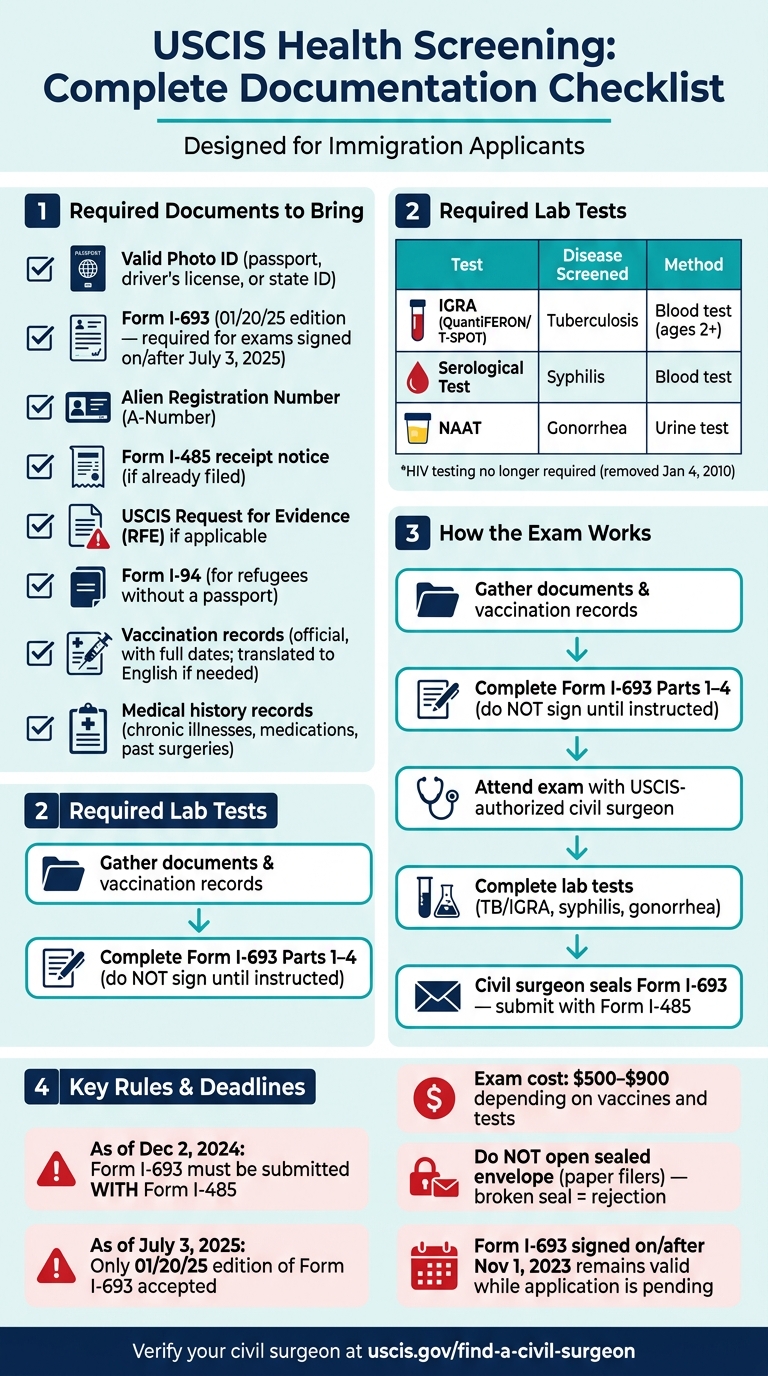
USCIS Medical Exam: Step-by-Step Documentation Checklist
Form I-693: Your Immigration Medical Exam Explained
sbb-itb-00cb036
Identity and Immigration Documents You Need to Bring
Showing up without the right documents can throw a wrench in your exam process. The civil surgeon must confirm your identity with a government-issued photo ID before starting the exam – and again if you’re sent to another lab or facility for additional tests, like a chest X-ray. To avoid delays, double-check that your ID is valid, easy to read, and matches the name on your immigration paperwork. Here’s a breakdown of what you’ll need.
Accepted Forms of Photo ID
A passport is your best bet since it confirms both your identity and nationality. However, a state-issued driver’s license or state ID card works, too. Just make sure the name on your ID matches exactly with the name on Form I-693 and all other USCIS documents. Even small differences – like an extra middle name – can lead to a Request for Evidence or possibly the rejection of your I-485 application.
Immigration Documents and USCIS Notices
Along with your photo ID, you’ll need to bring Form I-693, specifically the 01/20/25 edition. Starting July 3, 2025, this will be the only version USCIS accepts for exams signed on or after that date. Fill out Part 1 of the form before your appointment, but don’t sign it until the civil surgeon tells you to during the exam. You’ll also need your Alien Registration Number (A-Number) to connect your medical results to your USCIS case.
If you’ve already filed Form I-485, bring the receipt notice. And if USCIS has sent you a Request for Evidence (RFE) related to the exam, make sure to include that as well. Refugees without a passport should bring their Form I-94 (Arrival-Departure Record). These documents are crucial for linking your exam results to your case and meeting federal requirements.
| Document Category | What to Bring | Why It’s Needed |
|---|---|---|
| Photo ID | Passport, driver’s license, or state ID | Confirms your identity |
| Immigration Forms | Form I-693 (01/20/25 edition) and A-Number | Ensures your medical results tie to your USCIS case |
| USCIS Notices | Receipt notice for Form I-485 or RFE | Provides context for the exam request |
| Refugee Status | Form I-94 | Verifies eligibility for specific requirements |
Extra Documents Required for Minors
For minors, there are additional considerations. While they must meet the same ID requirements as adults, parents or guardians should also bring extra paperwork. If the minor doesn’t have a passport, a birth certificate or school-issued ID can serve as proof of identity. If the accompanying adult isn’t the child’s biological parent, legal guardianship papers are needed to confirm the authority to sign documents.
For children under 14, a parent or legal guardian can sign Form I-693 on their behalf. However, applicants aged 14 and older must sign the form themselves. If the minor is referred to another facility for lab work, that facility will also require a government-issued ID, so ensure it’s brought to every appointment.
Medical Records and Vaccine Documents
If you’re preparing for a USCIS health screening, having your medical history and vaccination records in order is crucial. Getting these documents ready ahead of time can make the process much smoother.
Medical History and Current Treatment Records
Make sure to bring detailed records of your medical history. This includes documentation of chronic illnesses, past surgeries, hospital stays, and any medications you’re currently taking. A printed summary from your electronic health record works just fine. If you have specific conditions like mental health issues, substance use disorders, or communicable diseases, include relevant records from specialists. Providing thorough documentation can help avoid delays or additional requests for information down the line.
Vaccination Records and Translation Rules
Your vaccination records need to be official and properly documented. Acceptable forms include medical charts, immunization cards, or printed records from a healthcare provider or facility. Self-reported vaccinations without written proof won’t meet the requirements. Each record should list the full date of vaccination (month, day, year). Incomplete or altered records – or those listing only the year – won’t be accepted.
If your records are in a language other than English, you must provide certified English translations. The CDC Technical Instructions for Civil Surgeons make this clear:
"The responsibility lies with the applicant to provide reliable English translations of all records." – CDC Technical Instructions for Civil Surgeons
For missing records, you have a couple of options. A blood titer test can confirm immunity for certain diseases, such as measles, mumps, rubella, hepatitis A, hepatitis B, polio, and varicella. If titers are unavailable or show no immunity, you’ll need to provide proof of receiving at least the first dose of the vaccine. Completing the entire series isn’t required for the civil surgeon to sign Form I-693.
The next section outlines the vaccines required by the CDC for immigration purposes.
CDC-Required Vaccines for Form I-693
As of March 11, 2025, the CDC mandates documentation for 15 vaccines for immigration purposes, with requirements varying based on age. Notably, COVID-19 vaccination will no longer be required as of January 20, 2025.
Here’s a summary of the required vaccines and their applicable age groups:
| Vaccine | Who It Applies To | Notes |
|---|---|---|
| MMR (Measles, Mumps, Rubella) | 12 months and older (born 1957 or later) | Titer accepted as proof of immunity |
| Tdap/Td (Tetanus, Diphtheria, Pertussis) | 7 years and older | Td booster required every 10 years |
| Polio (IPV) | All ages | All three types must be documented |
| Hepatitis B | Birth through 59 years | Titer accepted as proof of immunity |
| Varicella (Chickenpox) | 12 months and older | Reliable oral history may be accepted |
| Influenza | 6 months and older | Required only during Oct 1–Mar 31 (flu season) |
| Hepatitis A | 12 months through 18 years | Not routinely required for adults over 18 |
| Pneumococcal | Children under 5; adults 65+ | Also required for certain high-risk conditions |
| Rotavirus / Hib | Infants and young children | Not required for adults |
If a vaccine doesn’t apply to your age group, is medically contraindicated, or if there hasn’t been enough time between doses in a series, the civil surgeon can note a blanket waiver on Form I-693. For example, pregnant individuals are exempt from live vaccines like MMR and Varicella, and there’s no need to revisit these after delivery if marked as contraindicated.
Before your appointment, confirm with the civil surgeon’s office that the required vaccines are available.
For additional support with the USCIS health screening process, consider reaching out to USCIS Immigration Medical Exam Specialists for expert advice and assistance.
Lab Tests and How Results Are Documented
The USCIS medical exam involves more than just checking your vaccination records and medical history. It includes specific lab tests designed to screen for communicable diseases that could impact your eligibility to enter the United States.
Required Lab Tests for USCIS Medical Exams
Most applicants must undergo three main lab tests during the medical exam:
| Test Type | Target Disease | Who It Applies To | Method |
|---|---|---|---|
| IGRA (QuantiFERON or T-SPOT) | Tuberculosis | Applicants aged 2 and older | Blood test |
| Serological test | Syphilis | Age groups specified by the CDC | Blood test |
| NAAT | Gonorrhea | Age groups specified by the CDC | Urine test |
Notably, HIV testing is no longer required for the USCIS medical exam. Since January 4, 2010, HIV has been removed from the list of communicable diseases of public health concern.
For applicants with a positive IGRA result, additional testing is required. This includes a chest X-ray and, if the X-ray suggests active tuberculosis, a referral to the local health department for sputum testing. The sputum test involves collecting three samples over 24-hour intervals. These samples are then cultured for at least 6 weeks (liquid medium) or 8 weeks (solid medium) before a final negative result can be confirmed.
How Test Results and Follow-Ups Are Recorded
All lab results are recorded by the civil surgeon on Form I-693. Tuberculosis test results, including the specific IGRA test used (QuantiFERON or T-SPOT) and the numerical outcome, are detailed in Part 8, Section A.1. Results for syphilis and gonorrhea are documented in the "Findings" section under communicable diseases.
If a chest X-ray is required, a licensed radiologist must interpret the results before the civil surgeon can finalize the form. The civil surgeon cannot sign Form I-693 until all referral reports are completed and any necessary treatment for Class A conditions is administered.
"The civil surgeon is only permitted to sign the Form I-693 after the civil surgeon has completed the entire immigration medical examination. An examination is not completed until any necessary prescribed treatment for a Class A condition has been administered." – USCIS Policy Manual
For pregnant applicants, a chest X-ray may be deferred until after delivery. However, the civil surgeon cannot sign or submit Form I-693 until the X-ray has been completed and reviewed.
Keeping Your Own Records and the Sealed Envelope Rule
Before the civil surgeon seals your Form I-693, it’s essential to request a personal copy of the completed form and all related lab results. Once the envelope is sealed, you won’t be able to access these documents easily.
The sealed envelope rule is strict: if you’re submitting a paper Form I-485, the envelope must remain unopened when it reaches USCIS. Breaking the seal could lead to rejection or a Request for Evidence (RFE). However, there’s an exception for online filers. If you submit Form I-485 electronically, you’ll need to open the envelope to scan and upload the form. In this case, you must keep the original paper form and the opened envelope in case USCIS requests them during a future interview.
How to Complete and Protect Form I-693
What Applicants Must Fill Out on Form I-693
When it comes to Form I-693, you’re only responsible for completing Parts 1 through 4. Here’s how it breaks down:
- Part 1: Your personal details.
- Part 2: Your signature.
- Part 3: Interpreter information (if applicable).
- Part 4: Preparer information (if someone helps you complete the form).
The remaining sections – Parts 5 through 11 – are exclusively for the civil surgeon to complete.
One critical point: do not sign Part 2 before your medical exam appointment. USCIS is very clear about this:
"The applicant must sign the certification only when instructed by the civil surgeon, at the beginning of the immigration medical examination." – USCIS Policy Manual
When filling out Part 1, use black ink and ensure every detail matches your USCIS forms exactly. Once you’ve completed your sections, the civil surgeon takes care of the rest.
The Civil Surgeon’s Role in Signing and Sealing the Form
After completing your medical exam and receiving all lab results and referral reports, the civil surgeon fills out Parts 5 through 11. These sections document medical findings, vaccination records, and their certification. Importantly, the surgeon’s signature must be original and handwritten – stamped or photocopied signatures are not allowed.
"The civil surgeon’s signature must be an original signature. Stamps of the physician’s signature or other substitutes, or copies of the civil surgeon’s original signature, are not acceptable." – USCIS Policy Manual
Once the form is complete, the civil surgeon seals it in an envelope and hands it to you. Starting December 2, 2024, USCIS requires Form I-693 to be submitted alongside Form I-485 – separate submissions will no longer be accepted. Additionally, for exams conducted after July 3, 2025, only the 01/20/25 edition of the form will be accepted. Following these steps is essential to avoid any issues.
Common Mistakes and How to Avoid Them
Even with a clear understanding of your responsibilities and the civil surgeon’s role, there are a few common errors that can delay your application:
- Using an outdated form edition.
- Breaking the sealed envelope before submitting it to USCIS.
- Missing signatures.
- Incomplete vaccination records.
Before leaving the civil surgeon’s office, double-check the form for any errors. Make sure all required vaccine rows are completed – each one should be marked as administered, "not medically appropriate", or waived. No fields should be left blank.
It’s also a good idea to verify that your civil surgeon is authorized by checking their name in the USCIS "Find a Civil Surgeon" locator tool before your appointment.
"If the seal is broken when USCIS receives it, the form will be rejected and you will need to redo the exam entirely." – Oleg Gherasimov, Esq., SG Legal Group
Keep in mind that a Form I-693 signed on or after November 1, 2023, remains valid while your green card application is pending. However, if your application is denied or withdrawn, the form becomes invalid, and you’ll need a new medical exam for any future filings.
Special Documentation Cases
In some situations, additional paperwork is necessary to meet USCIS requirements. These special cases often involve extra steps to ensure everything is in order.
Documentation for a Prior Positive TB Test
If you’ve previously tested positive for TB, you’ll need more than the standard screening documents. Be sure to bring prior chest X-rays and treatment records to your appointment. The radiologist needs these to compare with your current films when available.
A written record of a prior positive IGRA test can exempt you from retesting. However, this record must include the test date, type, results (in standard units), interpretation, and the testing physician’s signature and contact details. A prior positive Tuberculin Skin Test (TST) alone does not exempt you from IGRA screening.
The civil surgeon assigns a TB classification based on your evaluation, which determines the next steps:
| TB Classification | What It Means | Next Steps |
|---|---|---|
| No Class A or B | Negative IGRA, no symptoms, no HIV | No further action required |
| Class B2 (Latent) | Positive IGRA, negative X-ray, no symptoms | Reported to health department; treatment recommended |
| Class B1 (Pulmonary) | Abnormal X-ray, negative sputum cultures | Health department referral; entered in eMedical |
| Class A TB | Active, communicable TB | Inadmissible until treatment is complete |
It’s important to note that the TB evaluation must be completed before the civil surgeon can sign Form I-693. Sputum cultures, if required, take at least 6–8 weeks to incubate.
Now, let’s look at how pregnancy alters vaccine requirements.
How Pregnancy Affects Vaccine Documentation
Pregnancy changes the rules for certain vaccines. Live vaccines, such as MMR and Varicella, are not safe during pregnancy. Instead of administering these, the civil surgeon will check the "Contraindication" box on Form I-693. This automatically grants a blanket waiver, meaning no extra applications or fees are required.
If your green card is approved after delivery, you won’t need to get the deferred vaccines. USCIS officers are instructed not to request additional evidence for these missing doses.
For TB screening, however, the process is stricter. Pregnant applicants can delay a chest X-ray until after delivery, but the civil surgeon cannot sign or submit Form I-693 until the X-ray has been completed and reviewed.
What to Do If Medical Records Are Lost or Incomplete
Lost or incomplete vaccination records are a common issue, especially for those vaccinated outside the U.S. USCIS allows laboratory tests (titers) to prove immunity for Measles, Mumps, Rubella, Hepatitis A, Hepatitis B, Polio, and Varicella. For Polio, the titer must confirm immunity to all three virus types.
Varicella is a bit different. A reliable oral or written history of having had chickenpox is acceptable without lab tests or vaccination. For other vaccines, confirmed immunity through titers means you won’t need additional doses.
If you can’t provide records or lab evidence, you’ll need to get one dose of each required vaccine during the medical exam. Additionally, vaccination entries in school, military, or employment records may qualify as valid documentation, so it’s worth checking these sources before your appointment.
Conclusion and Final Tips
Preparing for a USCIS health screening requires attention to detail and proper planning. Make sure to bring all necessary documents, understand what the civil surgeon requires, and familiarize yourself with the rules before your appointment.
Even small mistakes can lead to big problems. For instance, starting December 2, 2024, Form I-693 must be submitted together with Form I-485.
"Effective Dec. 2, 2024, you must submit Form I-693… with your Form I-485. Otherwise, we may reject your Form I-485." – USCIS
Double-check that the civil surgeon you choose is listed on the official USCIS locator and uses the 01/20/25 edition of Form I-693. Before leaving the appointment, confirm the envelope is properly sealed and request a personal copy for your records.
As of 2026, the cost of the exam typically falls between $500 and $900, depending on the required vaccines and lab tests. To minimize delays and unnecessary expenses, gather your vaccination history ahead of time to avoid additional doses.
For applicants in Los Angeles County, USCIS Immigration Medical Exam Specialists, led by Dr. Asher Ram, provides convenient options. They offer standard exams for $350 and rush exams for $475, with results available in as little as three days. The clinic handles the entire I-693 process in one visit, including the IGRA TB test, vaccine review, and proper document sealing. With over 27 years of experience and a reputation as the highest-rated immigration medical exam office in the area, this clinic is a reliable choice for those looking to get it right the first time.
Take the time to review all your documents carefully before submission to ensure everything goes smoothly.
FAQs
What should I do if my I-693 envelope is accidentally opened?
USCIS requires that Form I-693 remain sealed in the envelope provided by the civil surgeon. If the envelope is opened before submission, USCIS might reject or return it. Should your package be returned for other reasons and the envelope is opened, you can resubmit it along with a copy of the rejection notice. Additionally, USCIS may send a Request for Evidence (RFE) if the form appears to be improperly prepared or tampered with.
How do I handle missing or non-English vaccine records?
To assist the civil surgeon, bring all written vaccination records you have, such as personal immunization documents or copies from medical charts. Keep in mind: self-reported vaccinations without proper documentation won’t be accepted.
If your records are in a language other than English, you’ll need to provide a certified English translation. This must include the translator’s name, signature, contact details, and the date of translation.
If you don’t have vaccination records, the civil surgeon can help by either administering the necessary vaccines or conducting titer tests to check for immunity. They’ll also note any vaccines that aren’t medically appropriate or begin any required vaccination series if applicable.
What happens if my TB blood test is positive?
If your tuberculosis (TB) blood test, also known as an IGRA, comes back positive, the next step is a chest X-ray to determine if you have active TB disease. If the X-ray shows signs of infectious TB or you’re experiencing symptoms, you’ll be referred to your local health department for additional tests. However, if the X-ray is clear and you don’t have any symptoms, you’ll be diagnosed with a latent TB infection.
