

If you’re a USCIS-designated civil surgeon or planning to become one, here’s what you need to know:
- Initial Certification: This is a one-time process where physicians submit Form I-910, pay a filing fee, and provide proof of qualifications like an M.D. or D.O. degree, unrestricted medical license, and 4 years of professional experience (excluding training). Approval adds you to the USCIS Civil Surgeon Locator.
- Annual Review: USCIS conducts bi-annual audits to ensure designated civil surgeons remain compliant. No fees or forms are required, but physicians must notify USCIS within 15 days of changes like practice location or license updates.
- Compliance Risks: Failing to meet requirements – such as using the CDC‘s eMedical system or reporting changes – can result in revocation of designation. Errors on Form I-693 or license issues are common pitfalls.
- Consequences: Denials or revocations are final, with the only recourse being a motion to reopen or reapply. Staying compliant ensures smoother processes for both physicians and green card applicants.
| Process | Initial Certification | Annual Review |
|---|---|---|
| Goal | Verify qualifications | Ensure continued compliance |
| Fee | Required (Form I-910) | None |
| Frequency | One-time | Bi-annual audits |
| Key Risk | Denial for unmet qualifications or area needs | Revocation for compliance issues |
| Appeal Option | Motion to reopen (Form I-290B) | Motion to reopen (Form I-290B) |
Key Takeaway: Initial certification verifies eligibility, while the annual review ensures compliance. Both processes are critical for maintaining the integrity of immigration medical exams.
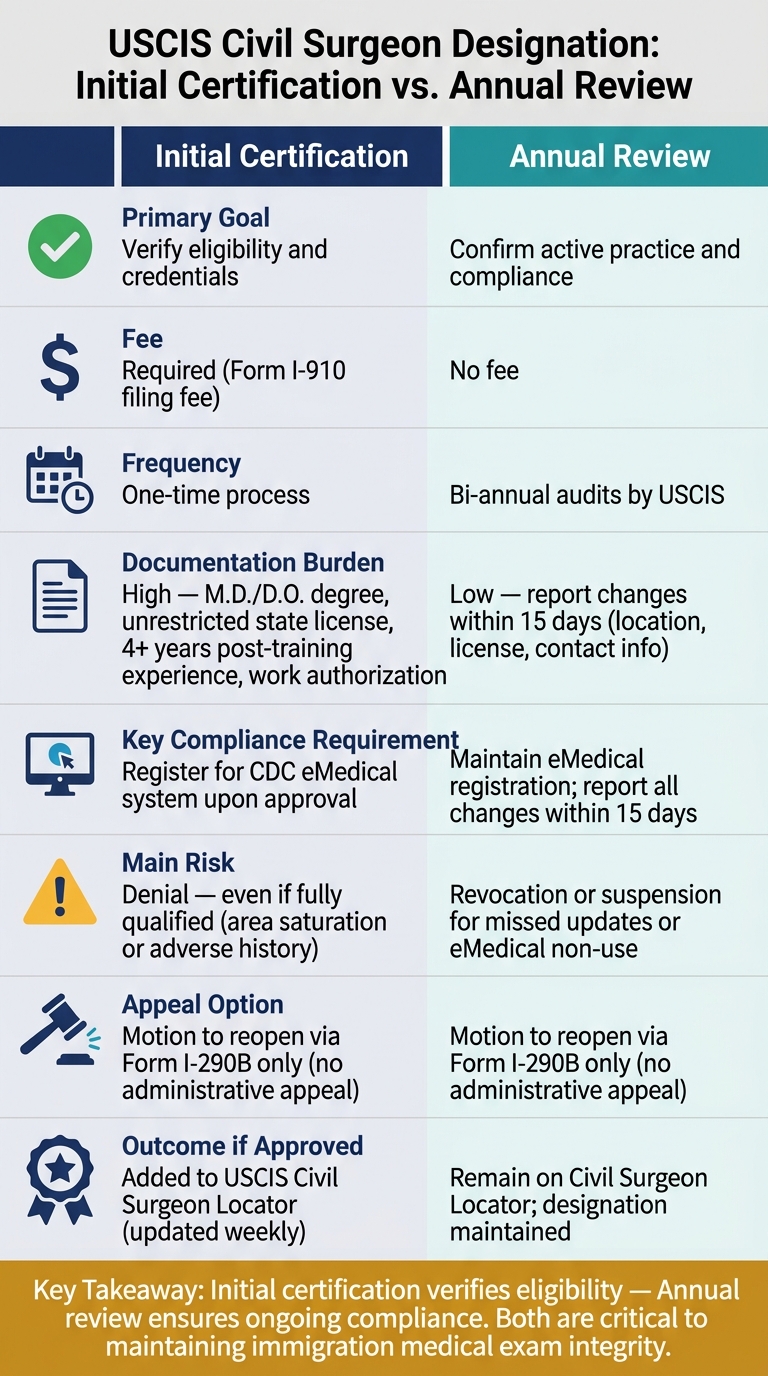
USCIS Civil Surgeon: Initial Certification vs. Annual Review
Initial Certification vs. Annual Review: A Quick Overview
These two processes have distinct purposes. Initial certification is a one-time evaluation to determine if a physician is qualified to perform immigration medical exams. On the other hand, the annual review ensures that already-designated physicians remain compliant, active, and properly listed. Let’s break down the unique steps and requirements for each.
To earn initial certification, a physician must submit Form I-910 along with the required filing fee and verified credentials. This includes holding an M.D. or D.O. degree, an unrestricted state medical license, and having at least 4 years of professional experience (internships and residencies don’t count). USCIS also conducts a thorough review of work authorization and checks for any adverse history, such as fraud or license suspensions, which could lead to denial – even if all technical qualifications are met.
The annual review process works differently. There’s no form to file or fee to pay. Instead, USCIS performs bi-annual audits of the nationwide civil surgeon list to ensure physicians are still practicing at their designated locations. Physicians must report changes – like updates to contact information, practice location, or license status – within 15 days.
One key compliance requirement for both processes is eMedical, the CDC’s electronic health processing system. Newly designated civil surgeons must register immediately. Failing to maintain this registration can result in revocation of their designation.
In summary, initial certification focuses on verifying eligibility, while the annual review ensures physicians remain compliant and active.
| Feature | Initial Certification | Annual Review |
|---|---|---|
| Primary Goal | Verify eligibility and credentials | Confirm active practice and compliance |
| Fee | Required filing fee | No fee |
| Frequency | One-time | Bi-annual audits; 15-day reporting for changes |
| Consequence of Failure | Denial of designation | Revocation or suspension of designation |
This comparison lays the groundwork for a closer look at the details of each process.
sbb-itb-00cb036
1. Initial Civil Surgeon Certification
Purpose and Objectives
The primary goal of the initial civil surgeon certification is to safeguard public health. USCIS assigns civil surgeons to examine immigration applicants for medical conditions that could make them inadmissible. These conditions include communicable diseases, missing vaccinations, physical or mental disorders linked to harmful behavior, and drug abuse or addiction.
"The health-related grounds of inadmissibility and the medical examination of applicants are designed to protect the health of the United States population." – USCIS Policy Manual
The results of these medical exams are documented on Form I-693, which USCIS uses to determine admissibility. Only physicians who meet strict qualifications are granted this designation. The next sections outline the application process and potential challenges.
Process and Requirements
Since March 11, 2014, USCIS has implemented a centralized application process for civil surgeon certification. Physicians must submit Form I-910 to a Lockbox facility, and the application is reviewed by the National Benefits Center (NBC).
"USCIS replaced the informal, decentralized civil surgeon application process with a formal, centralized process… to improve the application intake process, enhance case management, promote consistency and uniformity in decision-making, and improve the overall efficiency and integrity of the program." – USCIS Policy Manual
Key Requirements for Initial Certification
| Requirement | Details |
|---|---|
| Degree | Must hold an M.D. or D.O. |
| License | Must have a current, unrestricted state medical license |
| Experience | At least 4 years of professional practice after training |
| Work Authorization | Must be authorized to work in the U.S. |
| Application | Submit Form I-910 with the required fee and supporting documents, such as a copy of the medical degree, current license, and employment verification letters |
These requirements are specific to the initial certification process, forming the foundation for future compliance reviews.
Compliance and Risk Factors
Simply meeting the eligibility requirements doesn’t guarantee approval. USCIS conducts a discretionary review, looking into factors like prior fraud involvement or unresolved license issues. Even if an application is technically complete, it can still be denied if USCIS determines that the area’s civil surgeon needs are already met or if the applicant’s history raises red flags.
It’s important to note that only post-graduate professional experience counts toward the 4-year requirement. Any misrepresentation of credentials or qualifications could lead to a Request for Evidence (RFE) or outright denial.
Outcomes and Consequences
Approved applicants receive written confirmation and are added to the weekly-updated USCIS Civil Surgeon Locator. Once approved, physicians must register with eMedical, the CDC’s electronic health processing system. Failure to register can result in a violation of Technical Instructions, potentially leading to revocation.
For those whose applications are denied, there is no option for administrative appeal. The alternatives include filing a motion to reopen or reconsider using Form I-290B (which requires a fee) or reapplying after addressing the issues that led to the denial. Given the high stakes, it’s critical to ensure the application is accurate and complete on the first attempt. The next step in the process involves annual reviews to maintain compliance.
2. Annual USCIS Civil Surgeon Review
Purpose and Objectives
After earning the civil surgeon designation, physicians must meet ongoing requirements to maintain compliance with USCIS standards. Unlike the initial certification, this annual review ensures that physicians consistently adhere to these standards. USCIS reviews the entire civil surgeon list at least twice a year to confirm that listed physicians are actively conducting immigration medical exams, practicing at their approved locations, and holding valid medical licenses. The aim is clear: maintain an accurate public list and uphold the integrity of the immigration medical exam process.
Process and Requirements
To stay compliant, civil surgeons must continue practicing at their approved locations and maintain unrestricted medical licenses. Any changes to contact details, practice locations, or license status must be reported to the National Benefits Center (NBC) within 15 days. If a physician relocates to a different state, they are required to provide proof of licensure in that state to retain their designation.
Compliance also includes strict adherence to CDC Technical Instructions, accurate completion of Form I-693, and mandatory use of the eMedical system. The USCIS Civil Surgeon Locator is updated weekly, meaning any changes in a surgeon’s status can quickly become visible to the public. Failing to meet these requirements can lead to compliance risks, which are outlined below.
Compliance and Risk Factors
USCIS identifies several common issues that could trigger closer scrutiny during an annual review:
| Compliance Risk Factor | Description |
|---|---|
| Licensure issues | Restrictions or disciplinary actions on a medical license at the state level |
| eMedical non-use | Failing to use the required CDC system for reporting |
| Reporting failures | Not notifying USCIS of changes to contact details within the 15-day window |
| Form I-693 errors | Mistakes or incomplete information on medical exam forms |
| Fraud or misrepresentation | Involvement in immigration fraud or falsification of records |
Outcomes and Consequences
When a review uncovers problems – such as an unreported move or a license restriction – USCIS may issue a formal Notice of Intent to Revoke (NOIR). This notice is sent via Certified Mail, giving the physician 30 days to respond with evidence to address the issue. If the final decision leads to revocation, there is no administrative appeal process. The only recourse is filing a motion to reopen or reconsider using Form I-290B.
Revocation doesn’t just affect the surgeon – it can also disrupt the immigration process for applicants. If a civil surgeon is removed from the list, applicants may need to undergo a new medical exam with a different surgeon, potentially delaying green card processing. This underscores the importance of the annual review in maintaining the integrity of the immigration medical exam system.
Pros and Cons of Each Process
Looking at these processes side by side gives a clearer picture of the ongoing effort required from civil surgeons. Each process has its own purpose, benefits, and challenges. Understanding these nuances helps physicians better prepare, whether they’re applying for the first time or maintaining their designation.
The initial certification process requires substantial documentation. Physicians must provide proof of their M.D. or D.O. degree, an unrestricted state license, and at least four years of post-training experience, as previously mentioned. There’s also a filing fee for Form I-910, and even fully qualified applicants may face denial if USCIS determines the jurisdiction doesn’t need additional civil surgeons. According to the USCIS Policy Manual:
"There is no appeal from a decision denying designation as a civil surgeon. However, the physician may file a motion to reopen or reconsider."
The annual review, while less demanding, still requires diligence. No fee or re-submission is needed, but all changes – such as relocations or license updates – must be reported promptly. Failure to comply can have serious consequences, as USCIS makes clear:
"If you do not register for eMedical, we consider this failing to follow the Technical Instructions, and we may revoke your civil surgeon’s designation."
Here’s a quick comparison of the two processes:
| Feature | Initial Certification | Annual Review |
|---|---|---|
| Fee required | Yes (Form I-910 filing fee) | No |
| Documentation burden | High (degree, license, 4-year experience proof) | Low (change notifications, updated licenses if relocating) |
| Review frequency | Once, at time of application | Bi-annual minimum |
| Main risk | Denial – even with full qualifications | Revocation for missed updates or eMedical non-use |
| Appeal option | Motion to reopen via Form I-290B only | Motion to reopen via Form I-290B only |
| Compliance focus | Eligibility and background | Active practice and administrative accuracy |
This breakdown underscores the differences between the two processes. The initial certification is rigorous but happens only once, while the annual review is ongoing and rewards physicians who stay on top of administrative tasks. However, it leaves little room for error. For specialists in USCIS immigration medical exams, understanding these distinctions is key to staying compliant and running an efficient practice.
Conclusion
The initial certification and annual review processes play essential roles in maintaining the integrity of the civil surgeon designation. While the initial certification confirms a physician’s eligibility, the annual review ensures they continue to meet USCIS standards. Together, these steps uphold the accuracy of immigration medical exams and protect public health.
Remaining compliant requires consistent attention to detail. Common missteps – like failing to update practice information or not adhering to CDC Technical Instructions – can be avoided with regular updates and proactive measures.
Here are a few practices to help meet these requirements:
- Register for eMedical. USCIS views failure to register as a violation of Technical Instructions, which can lead to revocation of your designation.
- Set weekly reminders to verify your listing on the Civil Surgeon Locator, as USCIS updates this information weekly.
- Subscribe to USCIS email updates by selecting the "Civil Surgeons" option under the Outreach section on the USCIS "Get Email Updates" page. This ensures you stay informed about changes to policies and Form I-693.
For physicians conducting USCIS immigration medical exams – such as those at USCIS Immigration Medical Exam Specialists in Los Angeles – maintaining compliance not only helps secure their designation but also ensures efficient and accurate medical exams for green card applicants. This level of diligence directly supports smoother green card processing and contributes to the broader goal of safeguarding public health.
FAQs
How do I respond to a NOIR?
To address a Notice of Intent to Revoke (NOIR) from USCIS, you need to prepare a written, evidence-backed response and submit it within the specified deadline – usually 30 days. Start by carefully reviewing the notice to fully understand the reasons for the potential revocation. Your reply must be sworn under oath and directly respond to each issue raised, providing supporting documents wherever applicable. You have the option to handle this yourself or seek assistance from a private attorney. Failing to meet the deadline will lead to the revocation becoming final.
What changes must I report in 15 days?
You need to notify USCIS within 15 days if there are any changes that impact your civil surgeon designation. These changes include:
- Ceasing medical practice or halting immigration medical exams at your designated location.
- Any restrictions or disciplinary actions placed on your medical license.
- Updates to your contact details, such as your office name, address, phone number, fax, email, or if you add new office locations.
To report these updates, email NBCCivilSurgeons@uscis.dhs.gov.
How can I avoid I-693 mistakes?
To steer clear of errors on Form I-693, make sure it’s submitted in the sealed envelope provided by your civil surgeon – do not open or tamper with this envelope. Bring a valid photo ID and your vaccination records to your appointment to avoid delays. Ensure your civil surgeon completes and signs the form only after finishing all necessary exams and treatments. Finally, double-check that you’re using the latest version of the form to avoid any chance of rejection.
