

If you’re applying for a green card in the U.S., you must complete a medical exam using Form I-693. This ensures you meet health standards and are free from communicable diseases of public health concern. Here’s what you need to know:
- Blood Tests Required:
- TB (IGRA Test): Mandatory for ages 2+.
- Syphilis: Required for ages 18–44.
- Gonorrhea (NAAT): Mandatory for ages 18–24.
- Key Updates:
- HIV screening is no longer required (removed in 2010).
- COVID-19 vaccination is no longer required starting in 2025.
- As of December 2, 2024, Form I-693 must be submitted with Form I-485.
- Who Performs the Exam: Only USCIS-designated civil surgeons can conduct the exam and sign Form I-693.
- Preparation Tips:
- Bring valid ID, vaccination records, and any prior TB-related medical records.
- Use the official USCIS tool to find a designated civil surgeon.
- Schedule the exam close to your I-485 filing date to keep documents valid.
Properly completing these steps ensures compliance with USCIS requirements and helps avoid delays in your green card process.
I-693 Medical Exam: What You Need to Know Thinking about adjusting your status or applying for a
sbb-itb-00cb036
Blood Tests Required for I-693
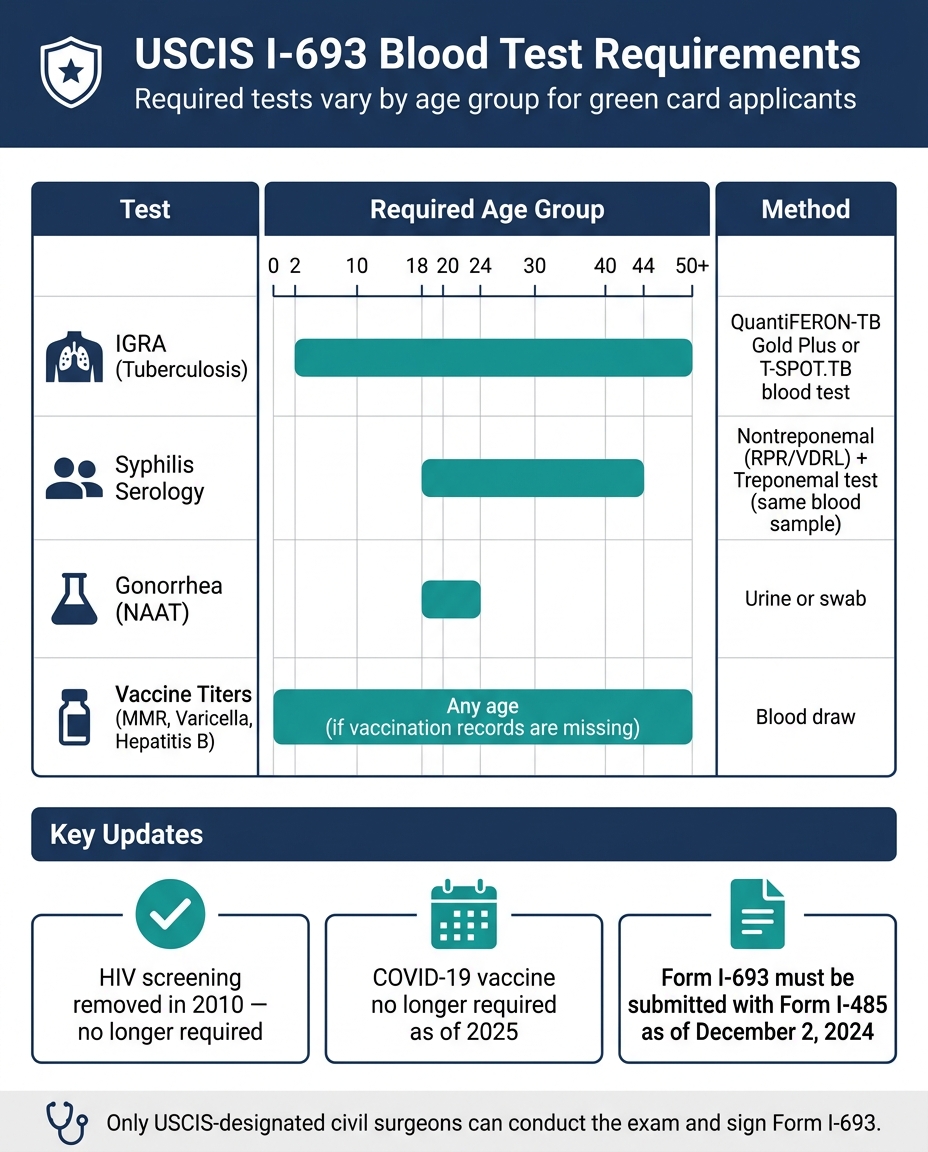
USCIS I-693 Blood Test Requirements by Age Group
Tuberculosis (TB) Blood Test
If you’re 2 years old or older, you’ll need an IGRA blood test for tuberculosis as part of the I-693 medical exam. This test has replaced the older tuberculin skin test (TST), which is now only used for children under 2 when it’s medically necessary.
The two FDA-approved IGRA tests accepted for this purpose are QIAGEN QuantiFERON-TB Gold Plus and Oxford Immunotec T-SPOT.TB. Even if you’ve had a BCG vaccination in the past, you’re still required to take an IGRA test.
"Civil surgeons must use an IGRA as defined in these instructions for all applicants ≥2 years of age." – CDC Tuberculosis Technical Instructions
If your IGRA result is positive, you’ll need a chest X-ray to rule out active tuberculosis. For indeterminate results, a repeat test is typically recommended instead of an automatic X-ray. Pregnant applicants are not exempt from TB screening, but if a chest X-ray is required, it can be postponed until after delivery. However, the I-693 form cannot be finalized until the chest X-ray is completed.
In addition to TB screening, syphilis testing is also a required part of the exam.
Syphilis Testing Requirements
Syphilis testing is mandatory for applicants aged 18 to 44. Civil surgeons must order two tests: a nontreponemal test (like RPR or VDRL) and a treponemal test (such as TP-PA, EIA, or CIA). Both tests must be conducted using the same blood sample.
"All applicants aged 18 years to those aged less than 45 years must be tested for evidence of syphilis." – CDC Technical Instructions for Civil Surgeons
Civil surgeons can use either the traditional or reverse screening method for these tests. While testing is primarily required for the 18–44 age group, individuals outside this range may also be tested if a syphilis infection is suspected.
It’s important to note that lab results from outside the immigration medical exam are not accepted. The syphilis tests must be ordered and completed during your exam.
"Testing performed elsewhere, or prior to the civil surgeon’s examination of the applicant, is not acceptable." – CDC Technical Instructions for Syphilis
Additional Laboratory Tests
Depending on your age and vaccination history, other blood tests may also be required.
One of the most common additional tests is for vaccine titers. If you don’t have written proof of your vaccinations, the civil surgeon might order blood tests to confirm immunity to diseases like Measles, Mumps, Rubella (MMR), Varicella (chickenpox), or Hepatitis B. To avoid unnecessary testing, bring your immunization records to the exam.
Here’s a quick overview of the required tests and their corresponding age groups:
| Test | Required Age Group | Method |
|---|---|---|
| IGRA (TB) | 2 years and older | QuantiFERON-TB Gold Plus or T-SPOT.TB |
| Syphilis Serology | 18 to 44 years | Nontreponemal and Treponemal tests (performed together) |
| Gonorrhea (NAAT) | 18 to 24 years | Urine or swab |
| Vaccine Titers | Any age (if records missing) | Blood draw for MMR, Varicella, Hepatitis B |
How to Prepare for Your I-693 Blood Tests
Documents to Bring to Your Appointment
To avoid unnecessary delays, make sure you bring the following items:
- A valid, government-issued photo ID: This could be an unexpired passport or a U.S. driver’s license. The civil surgeon will need this to confirm your identity.
- Vaccination records: Include all immunization documents, even if they’re in another language. Written proof of previous vaccinations can save you from needing extra blood tests for vaccine titers, which can cut down on both time and costs.
- The latest version of Form I-693: Use the 01/20/25 edition. Fill out Part 1 (your demographic details) in black ink before your appointment, but don’t sign or date it until the civil surgeon instructs you to. If you have an Alien Registration Number (A-Number), have that ready as well.
- TB-related medical records: If you’ve previously had tuberculosis, bring any chest X-ray films or treatment records you have. This can help the doctor differentiate between old scarring and active disease, potentially saving you from a lengthy sputum culture process.
Once you’ve gathered these documents, you’re ready to book your exam with a USCIS-designated civil surgeon.
How to Schedule Your Medical Exam
You can locate a USCIS-designated civil surgeon using the myUSCIS Find a Civil Surgeon tool or by calling the USCIS Contact Center at 800-375-5283.
Plan to schedule your exam at least two weeks ahead of time to allow for lab results to come back. For example, IGRA blood tests for tuberculosis usually take 24 to 72 hours to process. If the results are positive, you may need a follow-up chest X-ray. Most clinics require two visits: one for the initial exam and lab orders, and another to review results and pick up the sealed I-693 form.
Keep in mind that as of December 2, 2024, USCIS requires Form I-693 to be submitted along with your Form I-485 (Adjustment of Status) application. Also, the civil surgeon must sign the form no more than 60 days before you file your I-485. Make sure to schedule your exam with enough time to accommodate lab results and any follow-up visits.
When booking the appointment, ask if the clinic has the necessary vaccines on-site, such as Hepatitis B or Varicella. This can save you from needing to visit another provider.
Tips for the Day of Testing
A few easy steps can make your blood test go more smoothly. Start by drinking plenty of water before your appointment – being well-hydrated makes it easier to find veins for the blood draw. Wear loose or short-sleeved clothing to make the process even simpler.
You don’t need to fast for the blood tests required for tuberculosis, syphilis, or gonorrhea, but it’s always a good idea to double-check with the clinic when you schedule your appointment.
If you’re bringing a child, ensure you have documents that include their full name, date and place of birth, and the full names of both parents. Preparing your child by explaining what will happen during the blood draw can help ease their nerves.
Lastly, confirm with the clinic whether they have the required vaccines available. For instance, the MMR vaccine may cost $180 to $250 at an immigration clinic but could be significantly cheaper – around $20 to $80 – at a pharmacy or public health clinic. Planning ahead can save both time and money.
Understanding Your Blood Test Results and Next Steps
Normal vs. Abnormal Results
If your IGRA test comes back negative and your syphilis test is non-reactive, these are classified as "No Class", which means no further steps are needed. Understanding the classifications on your results is essential for knowing what actions, if any, are required next.
Here’s a quick breakdown of the classifications you might encounter:
| Condition | Finding | Classification | What It Means |
|---|---|---|---|
| TB | Negative IGRA, no symptoms | No Class | No further action required |
| TB | Active, infectious disease | Class A | Inadmissible until treatment is completed |
| TB | Positive IGRA, normal chest X-ray | Class B2 | Latent TB; reported to health dept., treatment optional |
| TB | Completed TB treatment | Class B0 | Cleared after full treatment |
| Syphilis | Reactive on both tests | Class A | Treatment required before form can be finalized |
| Syphilis | Post-treatment | Class B | Successfully treated; no longer a barrier |
Sometimes, a positive nontreponemal test isn’t confirmed by a treponemal test. This is often a false positive and is categorized as "No Class." False positives can happen during pregnancy, with age, or due to conditions like HIV or malaria.
If your results are positive, here’s what you need to know about the next steps.
What to Do If You Have a Positive Result
A positive result doesn’t mean your green card application is automatically denied. The key factor is how the result is classified and whether treatment is completed as needed.
For TB, a positive IGRA test requires a chest X-ray. If the X-ray shows abnormalities or you have symptoms, further sputum testing is needed. A "Class A" designation means you’re inadmissible until treatment is finished. Keep in mind that sputum culture results can take weeks. According to USCIS:
"The civil surgeon cannot sign off on the Report of Immigration Medical Examination and Vaccination Record (Form I-693) until any required steps relating to TB have been completed."
If you’re diagnosed with latent TB (Class B2), treatment isn’t mandatory, but the diagnosis must still be reported to the local health department.
For syphilis, a Class A result requires treatment with Benzathine penicillin G before the I-693 form can be finalized. Once treatment is successfully completed, the classification changes to Class B, and the medical exam process can move forward.
If you’ve been treated for TB or syphilis in the past, bring official documentation to avoid unnecessary delays or a Class A classification.
Promptly completing any required treatment keeps your I-693 form in good standing.
Keeping Your I-693 Form Valid
For forms signed by a civil surgeon on or after November 1, 2023, the I-693 remains valid indefinitely while your Form I-485 application is pending. However, if your I-485 is denied or withdrawn, the I-693 becomes invalid, and you’ll need a new medical exam for future applications.
Starting December 2, 2024, you must submit Form I-693 at the same time as your Form I-485. If you don’t, your application could be rejected or trigger a Request for Evidence (RFE).
Important: Do not open the sealed envelope your civil surgeon gives you! Opening it will void the form entirely if you’re mailing your application. The only exception is for online filing – if you submit Form I-485 online, you must open the envelope to scan and upload the I-693. Keep the original paper form and the opened envelope until USCIS makes a final decision.
Before the envelope is sealed, ask your civil surgeon for a personal copy of your completed I-693 and lab results. Having this record can be helpful if any issues arise later. It’s a small but smart step to ensure your peace of mind.
Why Choose USCIS Immigration Medical Exam Specialists

What the Clinic Offers for I-693 Testing
Located in Los Angeles, USCIS Immigration Medical Exam Specialists brings over 27 years of experience in conducting immigration medical exams. Each exam is carried out by a USCIS-designated civil surgeon, ensuring accuracy and compliance for I-693 form processing.
The clinic streamlines the entire I-693 process by offering everything you need in one visit. This includes a physical exam, on-site blood and urine tests, a vaccine review, and proper completion of the I-693 form. Once finished, you’ll receive a sealed envelope for USCIS submission and an unsealed copy for your records.
"Our USCIS I-693 doctors in Los Angeles understand the exact documentation and procedures required by immigration officials." – USCIS Immigration Medical Exam Specialists
This all-inclusive approach ensures you’re prepared for every step of the exam process, making scheduling and results straightforward.
Flexible Scheduling and Rush Processing Options
The clinic caters to urgent immigration timelines with flexible scheduling, including same-day and same-week appointments. Standard processing takes 7–9 days and costs $350, while the Rush Service provides results in 3–5 days for $475. Both options include required tests for TB, syphilis, gonorrhea, and chlamydia.
| Service | Price | Turnaround |
|---|---|---|
| Standard | $350 | 7–9 days |
| Rush | $475 | 3–5 days |
Vaccines are priced separately. For instance, the MMR vaccine costs $150, and Varicella is $200. If you’re unsure whether you need a vaccine, the clinic offers blood titer tests starting at $50 to check your immunity, potentially saving you from unnecessary vaccinations.
Support for Families and Immigration Attorneys
The clinic goes beyond medical exams by offering exceptional support, making it a great choice for families and legal professionals. They can accommodate multiple family members during one visit, and their multilingual staff ensures non–English speakers feel comfortable throughout the process.
Immigration attorneys frequently recommend the clinic due to its efficient communication with legal counsel. By providing your attorney’s contact details, the clinic can coordinate directly with them, reducing the risk of delays caused by incomplete or mismatched documentation.
"Attorneys consistently recommend our clinic because we combine medical precision with genuine human care." – USCIS Immigration Medical Exam Specialists
With top ratings on Yelp and Google, the clinic is recognized as the highest-rated immigration medical exam provider in Los Angeles County. These reviews reflect their commitment to delivering reliable service for a wide range of applicants and case types.
Conclusion
Key Takeaways for Green Card Applicants
Getting the right I-693 blood tests is crucial to avoid delays, extra appointments, or even application rejection. Here’s what you need to know: the IGRA blood test for tuberculosis is required for applicants aged 2 and older, while syphilis screening applies to those aged 18 to under 45, and gonorrhea testing is mandatory for applicants aged 18 to 24. Don’t forget to bring your vaccination records – self-reported immunizations without proper documentation won’t be accepted. Also, starting December 2, 2024, you’ll need to submit Form I-693 alongside Form I-485.
Final Tips for a Smooth Medical Exam
To make your medical exam process as easy as possible, keep these tips in mind:
- Check your doctor’s credentials: Ensure they are a USCIS-designated civil surgeon, as only their exams are valid.
- Use the correct form: Confirm the clinic uses the latest version of Form I-693 (dated 01/20/25) to avoid unnecessary delays.
- Handle the sealed envelope carefully: If mailing your application, never open the sealed envelope provided by the civil surgeon. For online filings, open it only to scan and upload the form, then keep the original sealed.
- Plan your exam timing wisely: Schedule your medical exam close to your I-485 filing date to ensure your documentation remains current.
If you’re in Los Angeles County, USCIS Immigration Medical Exam Specialists offers a convenient one-visit exam package. Standard results are available in 7–9 days for $350, or you can opt for rush results in 3–5 days for $475.
FAQs
How long is my I-693 valid after the civil surgeon signs it?
For forms signed on or after June 11, 2025, the I-693 remains valid as long as the related immigration application is still under review. However, if the application is denied or withdrawn, the form immediately loses its validity. For forms signed prior to November 1, 2023, the validity is limited to two years from the date of signature. USCIS Immigration Medical Exam Specialists are dedicated to ensuring your I-693 complies with all the latest requirements.
What happens if my TB IGRA test is positive or indeterminate?
If your IGRA test comes back positive, the next step is a chest X-ray to check for tuberculosis (TB). If the X-ray shows no abnormalities and you don’t have symptoms or HIV, you’ll be classified as having latent TB infection (LTBI). In this case, the civil surgeon will inform the local health department. If the test result is inconclusive, this will be recorded on your I-693 form, and retesting might be suggested.
Can I use blood test results from my own doctor instead of retesting at the exam?
No, you can’t use blood test results from your personal doctor for the I-693 form. According to USCIS regulations, all required tests, including those for gonorrhea, must be conducted during the immigration medical exam by a USCIS-approved civil surgeon. While you’re welcome to bring your medical or vaccination records for the doctor to review, the civil surgeon is responsible for completing all necessary screenings as outlined in the official guidelines.
