

If you’re applying for a green card, STD testing is part of the required medical exam (Form I-693). Here’s what you need to know:
- Tests Required: Only syphilis and gonorrhea are mandatory. HIV testing is no longer required since 2010.
- Age Guidelines:
- Syphilis: Testing is required for applicants aged 18 to under 45.
- Gonorrhea: Testing is required for applicants aged 18 to 24.
- How Tests Are Done:
- Syphilis: Blood test.
- Gonorrhea: Urine sample or vaginal swab (self-collected).
- Who Conducts the Tests: Only a USCIS-designated civil surgeon can perform the tests during the medical exam. Tests done elsewhere are not accepted.
- Positive Results: If an STD is detected, treatment must be completed before the medical exam can be finalized.
The medical exam also includes tuberculosis (TB) screening and vaccination reviews. Proper preparation, including bringing valid ID and vaccination records, can help avoid delays. Always ensure your Form I-693 remains sealed and untampered when submitting it to USCIS.
What Happens at the Immigration Medical Exam (I-693) and How Can I Prepare for Success?
sbb-itb-00cb036
Which STD Tests Are Required for Form I-693?
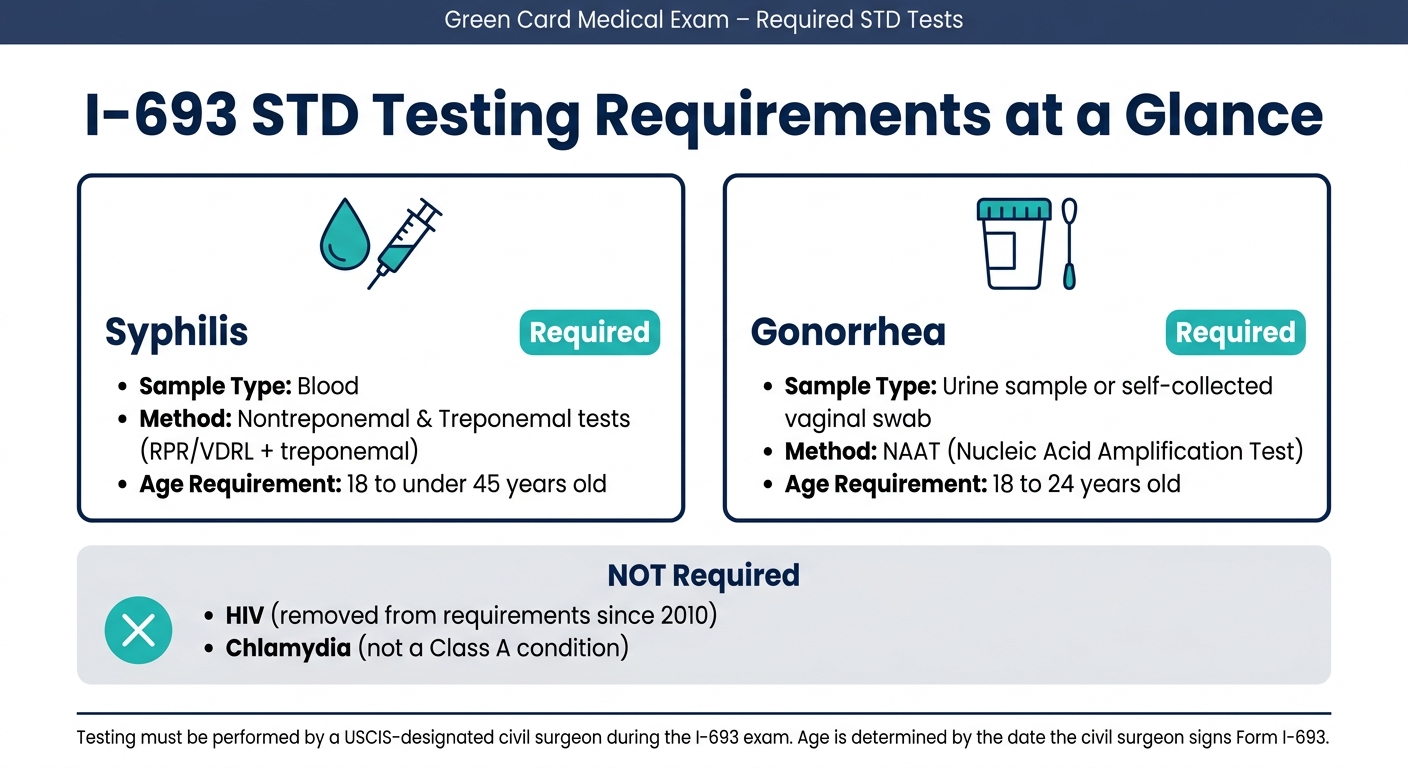
I-693 STD Testing Requirements at a Glance
This section explains the required STD tests and procedures for completing Form I-693.
For the I-693 immigration medical exam, only syphilis and gonorrhea tests are required under HHS regulations. Below, you’ll find details on the methods used and the age criteria for these tests.
Gonorrhea and Syphilis Testing
Testing for syphilis involves a blood sample and requires both nontreponemal and treponemal laboratory tests. Civil surgeons can follow either the traditional algorithm, which begins with a nontreponemal test like RPR or VDRL, or the reverse algorithm, starting with a treponemal test. Both approaches meet the requirements.
For gonorrhea, a Nucleic Acid Amplification Test (NAAT) is used, typically performed on a urine sample or a self-collected swab. The CDC specifies that for asymptomatic individuals, the least-invasive specimen type should be used. It’s important to note that gram stains are not acceptable; only NAAT results are valid.
"The gonorrhea nucleic acid amplification test (NAAT) must be ordered by the civil surgeon at the time of the immigration medical examination. Tests performed elsewhere, or prior to the civil surgeon’s examination of the applicant, are not acceptable." – CDC Technical Instructions
A genital exam is not part of gonorrhea screening, and for syphilis, external genital and rectal exams are only conducted if laboratory results confirm an infection.
Age-Based Testing Guidelines
Testing requirements also vary by age, with eligibility determined by the date the civil surgeon signs Form I-693 – not when USCIS processes your application.
- Syphilis testing: Required for individuals aged 18 to under 45.
- Gonorrhea testing: Required for those aged 18 to 24.
Outside these age groups, testing may still be necessary if the civil surgeon identifies clinical reasons, such as medical history or physical symptoms, to suspect an infection.
Chlamydia, despite being a common STD, is not included in Form I-693 testing requirements since it is not classified as a Class A condition.
How STD Tests Are Done During the I-693 Exam
Testing Methods Used
The I-693 exam includes two STD tests, each requiring a different type of sample. Syphilis testing is done using a blood sample, while gonorrhea testing typically involves a urine sample or, for women, a self-collected vaginal swab. Both tests are straightforward and minimally invasive.
For gonorrhea testing, the CDC explains:
"For asymptomatic applicants without risk factors, a urine specimen (men or women) or a self-collected vaginal swab (women) must be used for the NAAT." – CDC
If symptoms or risk factors are present, the civil surgeon may decide to use oral or rectal swabs based on their clinical judgment. For syphilis, the surgeon will check for visible signs like oral sores or rashes on the hands and feet. A genital or rectal exam is only performed if lab results confirm an infection, and a chaperone will be present during such an exam. These tests are part of the broader medical evaluation conducted during the I-693 process.
How STD Tests Fit Into the Full I-693 Lab Work
STD tests are just one part of the comprehensive lab work required for the I-693 exam. Alongside gonorrhea and syphilis tests, applicants aged 2 and older must also undergo TB screening using an IGRA blood test. For most adults, this means providing both a blood sample (for syphilis and TB) and a urine sample (for gonorrhea) during the same appointment. All tests must be completed as part of the exam.
| Test | Sample Type | Method |
|---|---|---|
| Syphilis | Blood | Nontreponemal & Treponemal tests |
| Gonorrhea | Urine or vaginal swab | NAAT |
| Tuberculosis | Blood | IGRA |
The results of these tests, along with other required lab work, are documented in Part 8 of Form I-693. The form cannot be signed off by the civil surgeon until all lab results have been received and reviewed.
What Happens If an STD Test Comes Back Positive?
Follow-Up and Treatment
If your STD test comes back positive, it puts a temporary hold on finalizing your medical exam until the infection is treated. Initially, a positive result is classified as a "Class A" condition, but this classification changes after successful treatment.
For gonorrhea, treatment is administered onsite and directly observed by the civil surgeon. In the case of syphilis, the CDC recommends Benzathine penicillin G (BPG) as the primary treatment option. The civil surgeon is responsible for documenting every step of the treatment process.
"Civil surgeons must treat gonorrhea according to CDC’s STI Treatment Guidelines… before the medical report form is completed and signed." – CDC Technical Instructions
These treatments must be fully completed before the medical review of Form I-693 can proceed.
How Positive Results Affect Form Completion
After completing and documenting the treatment, the process of finalizing Form I-693 can move forward. However, the civil surgeon cannot sign off on the form until all necessary treatments for a "Class A" condition are finished:
"An examination is not completed until any necessary prescribed treatment for a Class A condition has been administered." – USCIS Policy Manual
Once the treatment is complete, the applicant’s classification changes to "Class B." This means the condition no longer disqualifies the individual permanently, though the medical exam remains incomplete until all required steps are fulfilled.
If an applicant refuses treatment, the refusal will be noted on Form I-693, and USCIS will consider the applicant inadmissible. In such cases, filing Form I-601 for a waiver becomes necessary to continue the immigration process.
How to Prepare for Your I-693 Exam
What to Bring to Your Appointment
Being prepared for your I-693 exam is key to avoiding delays. Start by bringing a valid, government-issued photo ID – like an unexpired U.S. passport or a state driver’s license – since the civil surgeon needs to confirm your identity before conducting any tests.
Make sure to have your vaccination records, which must include the month, day, and year of each dose. Self-reported vaccination histories won’t be accepted. If your records are in another language, you’ll need to provide a reliable English translation. Missing records? No problem – titer tests (blood tests that confirm immunity) can be used for vaccines like MMR, Hepatitis A, Hepatitis B, and varicella.
Before your appointment, complete Part 1 of Form I-693 (Edition 01/20/25), but don’t sign Part 2 until the civil surgeon advises you to do so. Additionally, bring any relevant medical documents, such as records of tuberculosis treatment, chronic conditions, or prior diagnoses. These details help the civil surgeon complete your form accurately.
Timing matters too. If you’d prefer to skip the seasonal influenza vaccine, schedule your exam between April 1 and September 30, as the flu shot is only required during flu season (October 1 through March 31).
A little preparation goes a long way in ensuring your exam day runs smoothly and makes the most of the services offered by a USCIS exam provider.
Why Choose USCIS Immigration Medical Exam Specialists?
USCIS Immigration Medical Exam Specialists is a Los Angeles-based clinic that simplifies the entire I-693 process. Their standard service costs $350 and includes a full physical exam, the Quantiferon TB Gold blood test, an RPR/syphilis test, and urine tests. Results are typically ready in 7–9 days. Need it faster? Their Rush Service, priced at $475, delivers a sealed Form I-693 in just 3–5 days.
The clinic’s all-in-one approach eliminates the hassle of coordinating tests across multiple locations. They also provide vaccine reviews, vaccine administration, and blood titer services. With flexible scheduling options – including same-day appointments – and family-friendly services, this clinic is a convenient choice for residents of Los Angeles County.
Conclusion
STD testing plays an important role in the I-693 medical exam. Syphilis testing is mandatory for all applicants aged 18 to under 45, while gonorrhea testing is required for those aged 18 to 24. For individuals outside these age groups, additional testing may be conducted based on the civil surgeon’s clinical judgment.
The CDC emphasizes: "Testing performed elsewhere, or prior to the civil surgeon’s examination of the applicant, is not acceptable." Testing must be completed during the exam by a USCIS-designated civil surgeon to meet requirements.
It’s also critical to keep your sealed Form I-693 envelope intact. USCIS will reject the form if the envelope has been opened or tampered with in any way.
Choosing a USCIS-approved civil surgeon simplifies the process. They handle lab orders, follow CDC protocols, and ensure your form is sealed and ready for submission. By following these steps – accurate testing, timely treatment if necessary, and maintaining the integrity of your documentation – you can avoid unnecessary delays and keep your green card process on track.
FAQs
Can I use STD test results from my own doctor?
No, you can’t use STD test results from your personal doctor for the I-693 form. For this form, syphilis and gonorrhea tests must be ordered and documented by a USCIS-designated civil surgeon during the immigration medical exam. These tests need to comply with CDC guidelines and must be conducted on-site to meet USCIS requirements. While you can bring your medical records, the civil surgeon is still required to carry out the necessary screenings.
Does the civil surgeon do a genital exam for these tests?
The civil surgeon does not perform a genital exam for the gonorrhea test during the immigration medical exam. Likewise, an external genital exam for syphilis is unnecessary unless there is laboratory confirmation of a diagnosis. Our USCIS-approved doctors in Los Angeles handle all required blood and urine tests to ensure you meet your I-693 requirements. Book your appointment today for a hassle-free exam process.
Will a past treated STD delay my I-693?
If you’ve previously been treated for an STD, it usually won’t hold up your I-693 process as long as you meet the current health requirements. During the immigration medical exam, USCIS civil surgeons are required to test for syphilis and gonorrhea, and they won’t accept prior lab results. The emphasis is on your current health status to determine whether you’re admissible. Our team makes sure all required tests and vaccine reviews are handled correctly to keep the process running smoothly.
