

The green card medical exam is a required health screening for U.S. immigration applicants. Its purpose is to identify medical conditions that might make someone inadmissible under U.S. law. Here’s what you need to know:
- Who Can Perform the Exam: Only USCIS-approved civil surgeons (in the U.S.) or panel physicians (outside the U.S.) are authorized to conduct the exam. Your regular doctor cannot perform it.
- What It Includes: The exam involves a review of your medical history, a physical exam, mental health evaluation, lab tests (for TB, syphilis, and gonorrhea), and a vaccination assessment.
- Required Documents: Bring a valid photo ID, vaccination records, Form I-693 (partially filled out), and any relevant medical history documents.
- Costs: Fees vary by clinic and location. Expect to pay $350–$475 for the exam, with additional charges for lab tests and vaccines.
- Timeline: The process typically takes 3–10 days from the initial visit to receiving your sealed Form I-693, which must remain unopened for submission to USCIS.
This exam is not a general health check-up but a targeted evaluation to meet immigration health requirements. Proper preparation ensures a smooth process.
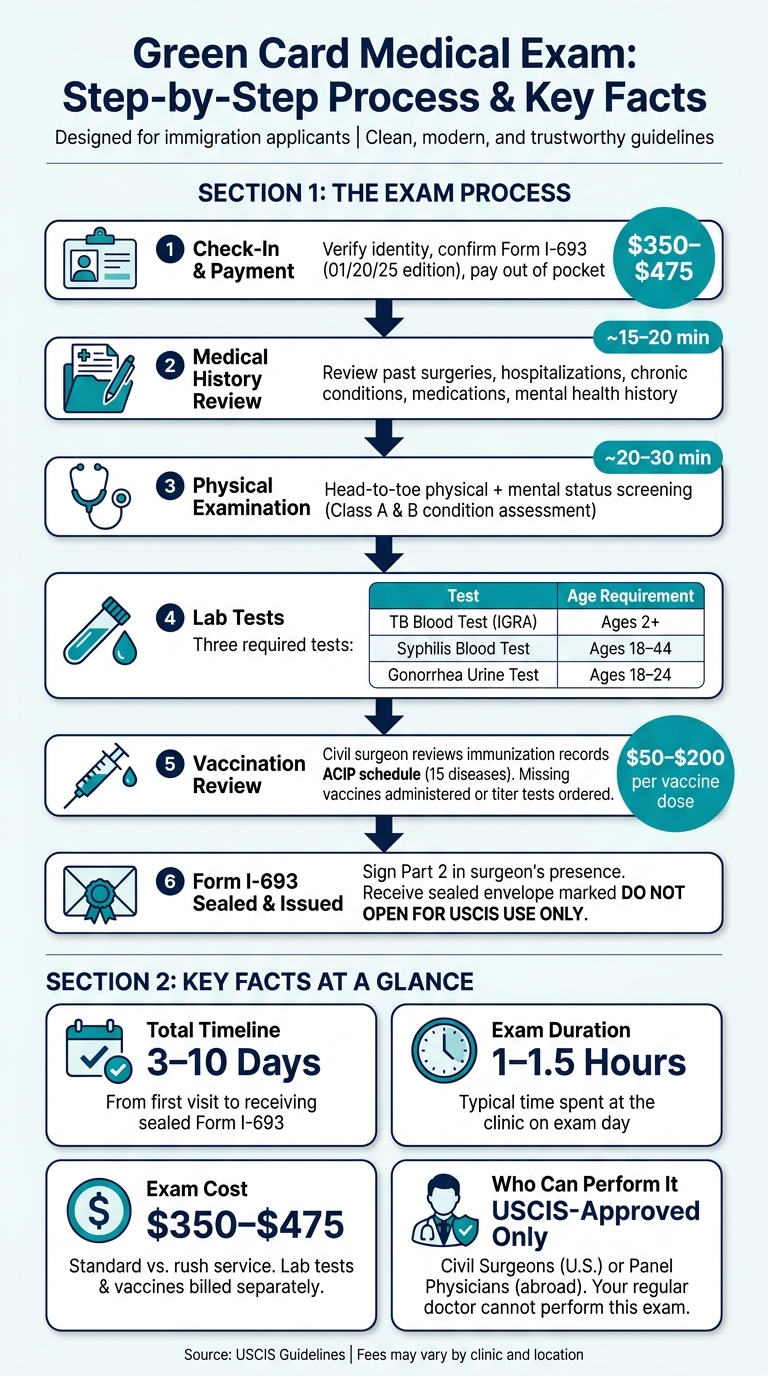
Green Card Medical Exam: Step-by-Step Process & Key Facts
How to Prepare for Your Green Card Medical Exam
Documents to Bring
Having the right paperwork on hand can save you a lot of time and stress. Make sure to bring a valid, unexpired government-issued photo ID – your passport is usually the best option. You’ll also need your vaccination records, complete with exact dates, and the latest version of Form I-693 with Part 1 filled out (but don’t sign it yet). If your vaccination records aren’t in English, include translated copies so the civil surgeon can accurately review your history.
For those with a history of positive tuberculosis tests, bring a certificate from your doctor confirming you’ve received proper treatment, along with any previous chest X-ray films. If you have chronic illnesses or mental health conditions, a letter from your doctor outlining your treatment plan can help avoid complications during the process.
| Document Category | What to Bring |
|---|---|
| Identification | Passport, driver’s license, or state-issued ID |
| Immigration Forms | Form I-693 with Part 1 completed (wait to sign it in front of the surgeon) |
| Vaccination Records | Official records with complete dates for each vaccine dose |
| Medical History | Chest X-rays, list of medications, hospitalization records |
| Special Cases | TB clearance certificate, mental health treatment letters, etc. |
Important: Do not sign Form I-693 before your appointment. You’ll need to sign it in the presence of the civil surgeon to ensure proper processing.
Bringing these documents ensures your Form I-693 can be completed smoothly. Once you’ve gathered your paperwork, it’s time to think about fees and scheduling.
Fees and Scheduling
The cost of the medical exam isn’t standardized, so prices vary depending on the clinic. For instance, in Los Angeles, USCIS Immigration Medical Exam Specialists charge $350 for a standard exam (results in 7–9 days) and $475 for a rush exam (results in 3–5 days). Keep in mind that lab tests – like the TB blood test (IGRA), syphilis screening, and gonorrhea test – are typically billed separately. If you need additional vaccines, expect to pay anywhere from $50 to $200 per dose. Since most clinics don’t accept health insurance for these exams, plan to pay out of pocket.
"USCIS does not regulate the fees that civil surgeons charge to perform an immigration medical examination." – USCIS
To avoid surprises, schedule your appointment early and confirm the fees in advance. Being aware of these details can make the entire process much smoother.
General Preparation Tips
Wear loose, comfortable clothing to your appointment, and don’t forget any assistive devices you use regularly.
To save on costs, consider getting any missing vaccines at a pharmacy or through your primary care doctor before your exam. Clinics often charge more for vaccines than pharmacies, so comparing your vaccination records against the CDC immunization schedule beforehand can help you avoid extra expenses.
You’ll also need to discuss your medical history during the exam. Be ready to talk about past hospitalizations, chronic conditions, or any history of substance use. While this isn’t a full health check-up, being honest and thorough will help ensure the process goes smoothly and your results are processed without unnecessary delays.
sbb-itb-00cb036
Form I-693: Your Immigration Medical Exam Explained
What to Expect on Exam Day
The exam typically takes between 1 and 1.5 hours, and understanding the process can help reduce any stress.
Check-In and Initial Steps
When you arrive, the staff will confirm your identity using a government-issued photo ID, such as a passport. They’ll also check your Form I-693 to ensure you’re using the correct 01/20/25 edition and that Part 1 is completed but not signed. At this stage, you’ll need to make a payment. Most civil surgeons require payment out of pocket since they don’t usually accept health insurance for immigration exams.
Once these steps are complete, the process moves on to a detailed review of your medical history.
Medical History Review
The medical history review takes about 15–20 minutes. During this time, the staff will ask about past surgeries, hospitalizations, chronic conditions, medications, and any history of alcohol or psychoactive drug use. They’ll also inquire about psychiatric illnesses or behaviors that could be considered harmful.
The doctor will assess for Class A conditions (which may bar entry) and Class B conditions (notable health issues that are documented but don’t automatically disqualify you). If you’ve had mental health treatment in the past, bringing a dated letter from your psychiatrist confirming your stability can save you from being referred to a government-appointed specialist, which can be costly.
"The legal standard is ‘harmful behavior’ – documented violence, repeated suicidal attempts with hospitalization, or active substance abuse with a pattern of public endangerment." – Immigration Start Guide
It’s worth noting that marijuana use, even in states where it’s legal, could result in a 12-month remission requirement under federal guidelines.
Physical Examination
After the medical history review, you’ll proceed to the physical exam, which lasts around 20–30 minutes. You’ll be asked to change into a medical gown so the doctor can perform a thorough head-to-toe assessment. This includes checking your height, weight, blood pressure, and heart rate, as well as examining your eyes, ears, nose, throat, heart, lungs, abdomen, lymph nodes, skin, and extremities.
A mental status screening is also part of the exam. The doctor will evaluate your thought process, judgment, mood, and behavior – focusing on identifying any Class A or Class B conditions. It’s important to know that a mental health diagnosis alone isn’t disqualifying. What matters is whether there’s a documented history of harmful behavior.
"A mental health diagnosis on its own, without those specific behavioral elements, is not disqualifying." – Oleg Gherasimov, Esq., SG Legal Group
Lab Tests and Vaccination Assessment
At USCIS Immigration Medical Exam Specialists, once the physical exam is complete, USCIS-approved civil surgeons handle the next steps: conducting lab tests and reviewing vaccination records. This process is essential to screen for communicable diseases, as required by federal guidelines.
Required Lab Tests
Most adult applicants need to undergo three specific tests:
| Test | Who It’s Required For | Detection |
|---|---|---|
| TB Blood Test (IGRA) | Ages 2 and older | Mycobacterium tuberculosis |
| Syphilis Blood Test | Ages 18–44 | Infectious stage syphilis |
| Gonorrhea Urine Test (NAAT) | Ages 18–24 | Communicable gonorrhea |
If the TB test comes back positive – or if you show symptoms or are HIV-positive – a chest X-ray is required to rule out active tuberculosis. Active TB is classified as a "Class A" condition, which could lead to inadmissibility. However, latent TB is recorded as a "Class B" condition and does not disqualify applicants.
"Civil surgeons must not sign Form I-693 until the referral evaluation section has been completed and received back from the appropriate health department [in TB cases]." – USCIS Policy Manual
Once the lab tests are completed, the focus shifts to ensuring your immunization records meet the required standards.
Vaccination Review and Administration
During the exam, the civil surgeon evaluates your immunization records based on the schedule recommended by the Advisory Committee on Immunization Practices (ACIP). Vaccines commonly required include MMR, Polio, Tdap, Varicella, Hepatitis A and B, seasonal Influenza (if applicable), and others – covering a total of 15 diseases.
Only documentation of the first dose is necessary. If your records are incomplete, the doctor may either administer the vaccine or order titer tests to confirm immunity. This approach can help avoid unnecessary duplicate vaccinations. As Oleg Gherasimov explains:
"Duplicate vaccines are not harmful, but they cost money and they’re avoidable." – Oleg Gherasimov, Esq.
Make sure to bring all official immunization records, including any foreign vaccination booklets with reliable English translations. Self-reported vaccination histories without proper documentation won’t be accepted. Individual vaccines typically cost between $50 and $200 per dose. Notably, as of 2025, the COVID-19 vaccine is no longer required for the I-693 exam.
Special circumstances may call for adjustments to these guidelines, as outlined below.
Special Cases: Pregnant Applicants, Children, and Chronic Conditions
Vaccine and lab test requirements can vary based on individual circumstances. For pregnant applicants, chest X-rays – and in some cases, the entire medical exam – can be postponed until after delivery. Live vaccines that are contraindicated during pregnancy are also deferred, and the I-693 form will remain unsigned until all requirements are met.
For children, syphilis and gonorrhea tests are generally not required, although the TB blood test is mandatory for those aged 2 and older. Vaccination requirements depend on age; for instance, Rotavirus vaccines are typically needed only for infants, while the Meningococcal vaccine is required for those aged 11 to 18.
Chronic conditions like diabetes or high blood pressure do not automatically make an applicant inadmissible. As Oleg Gherasimov emphasizes:
"The medical exam’s inadmissibility grounds are defined by federal law and are specific. Having diabetes does not make you inadmissible. Obesity does not make you inadmissible."
If you have a well-managed chronic condition, bringing a letter from your treating physician outlining your treatment plan can help streamline the review process. In some cases, vaccines may be waived if they are deemed medically inappropriate for your condition.
After the Exam: Results and Next Steps
How the I-693 Form Is Completed
Once your lab results and vaccination updates are ready, the civil surgeon compiles everything into Form I-693. This includes reviewing your tuberculosis, syphilis, and gonorrhea test results, as well as confirming your immunization records. The surgeon then documents their findings regarding your admissibility. You’ll need to sign Part 2 of the form in the surgeon’s presence. After that, the civil surgeon will sign and date the form, but only after all necessary health follow-ups – like additional tuberculosis testing – are completed.
"The I-693 is not signed or dated by the doctor until the applicant has met all health-related follow-up requirements." – VisaNation Law Group
Once the form is complete, it moves on to the sealed packet stage, which is explained below.
Receiving Your Sealed Packet
After finalizing the form, the civil surgeon seals Form I-693 and its supporting documents in an envelope marked "DO NOT OPEN. FOR USCIS USE ONLY." You will also receive an unsealed copy of the form and your vaccination record for personal use. This copy can come in handy for things like school enrollment or job applications.
How you handle the sealed envelope depends on your filing method:
| Filing Method | Instructions for the Sealed Envelope |
|---|---|
| Mail-in (Form I-485) | Keep the envelope sealed and include it in your application package. |
| Online (Form I-485) | Open the envelope to upload a digital copy, but keep the physical original for your interview. |
"Do not break the seal or open this envelope. We will not accept Form I-693 if it is not in a sealed envelope or if the envelope is altered in any way." – USCIS
Make sure the civil surgeon uses the most recent version of Form I-693 (currently the 01/20/25 edition). Submitting an outdated version will result in rejection.
Once your sealed packet is ready, the next steps follow specific timelines.
Processing Timelines
The medical exam itself may only take one to two hours, but the overall process includes waiting for lab results and updating vaccinations. For example, at USCIS Immigration Medical Exam Specialists in Los Angeles, the typical service takes about 7–9 days and costs $350. If you need faster results, expedited service is available, delivering results within 3–5 days for $475.
| Step | Estimated Timeframe |
|---|---|
| Lab tests and vaccination updates | 2–5 business days |
| Completion and sealing of Form I-693 | Same day to 3 days after receiving results |
| Total time from first visit | 3–10 days |
Forms signed on or after November 1, 2023, do not expire while your I-485 application is pending. To avoid complications, it’s best to schedule your medical exam close to your filing date to ensure all documents remain current.
FAQs
What can delay my I-693 being sealed?
Delays in receiving your sealed Form I-693 can happen for several reasons. If you need additional lab work, tuberculosis screening, or follow-up vaccinations, the civil surgeon cannot complete the form until everything is finished. Mistakes like errors, missing signatures, or incomplete sections on the form can also slow things down, as USCIS may require corrections. To avoid starting over, make sure your civil surgeon is authorized by USCIS.
Can I use vaccine titers instead of shots?
Yes, vaccine titers can help fulfill vaccination requirements if you don’t have records of previous vaccinations. A civil surgeon may request a blood test (titer) to check for immunity to certain diseases. This lab result is accepted by USCIS and can save you from getting unnecessary vaccinations. Specialists in USCIS Immigration Medical Exams provide these tests and complete the I-693 form needed for your green card application.
Will past marijuana use affect my medical exam?
Yes, previous marijuana use could affect your medical exam. Civil surgeons are tasked with checking for drug abuse and addiction. Even if your marijuana use happened in a place where it was legal, it might still be recorded as drug abuse. This could result in inadmissibility. If that happens, you may need to show 12 months of documented remission before your I-693 can be approved.
