

If you’re applying for a U.S. Green Card, you can’t rely on your regular doctor for the required immigration medical exam. Only a USCIS-designated civil surgeon can perform this exam and certify Form I-693. Here’s a quick breakdown:
- Civil Surgeons: Authorized by USCIS to conduct immigration exams, follow CDC guidelines, and certify Form I-693. They focus on identifying health conditions that may affect U.S. admissibility.
- Regular Doctors: Provide routine care under state licenses but cannot perform immigration exams or sign Form I-693.
Key points to remember:
- Immigration exams cost $200–$500 (not covered by insurance).
- You need to bring vaccination records and ID to your civil surgeon appointment.
- Forms must be sealed and signed correctly, or USCIS will reject them.
Quick Comparison:
| Feature | Civil Surgeon | Regular Doctor |
|---|---|---|
| Authorized for Form I-693 | ✅ Yes | ❌ No |
| Overseen by USCIS | ✅ Yes | ❌ No |
| Follows CDC Technical Instructions | ✅ Yes | ❌ No |
| Role in Immigration Process | Conducts full exam, certifies results | Provides medical history, vaccination records |
Choose a civil surgeon through the USCIS "Find a Doctor" tool to avoid delays or extra costs.
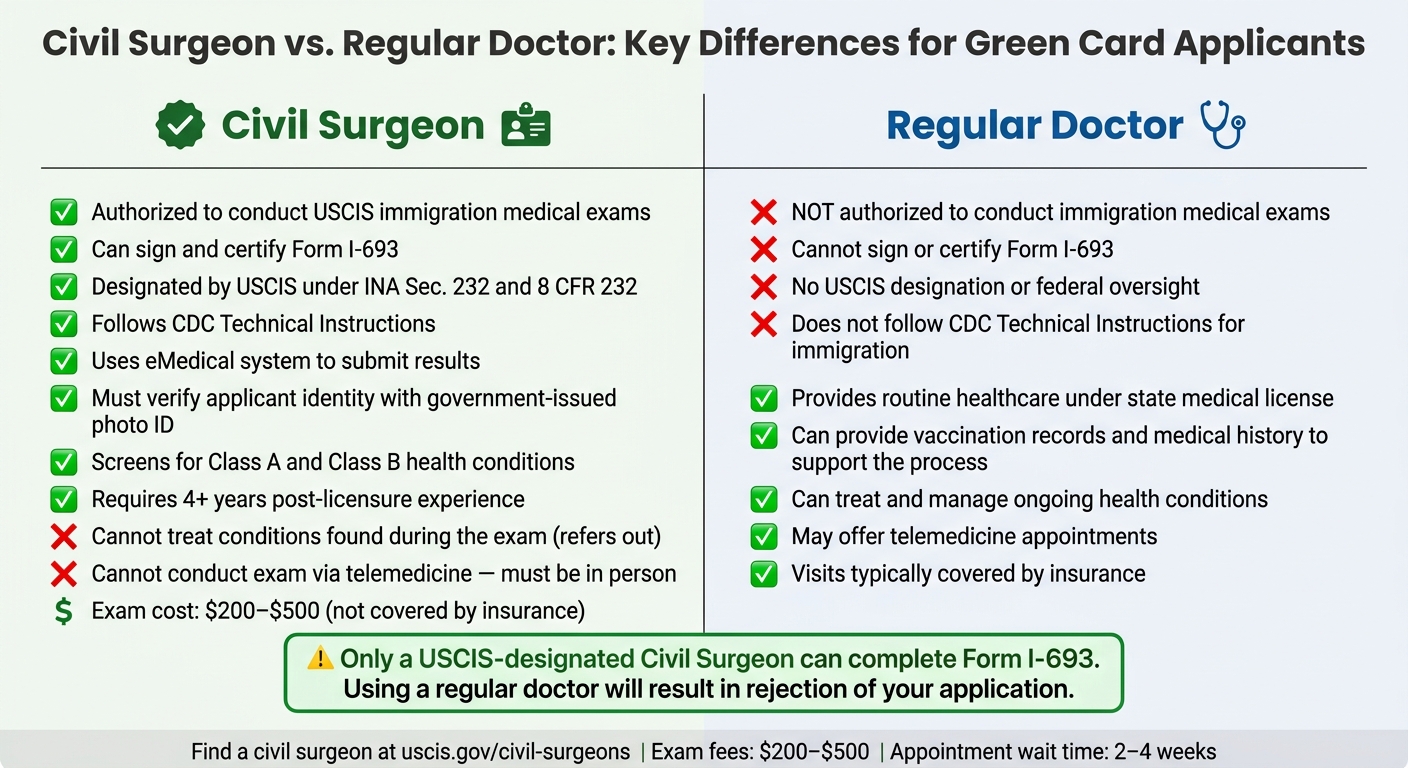
Civil Surgeon vs. Regular Doctor: Key Differences for Green Card Applicants
Interview with a USCIS Civil Surgeon – Everything You Wanted to Know About the I-693 Medical Exam
sbb-itb-00cb036
Key Differences in Roles and Legal Authority
Civil surgeons and regular doctors differ in their federal legal authority, not in their overall medical expertise. A civil surgeon is specifically designated by USCIS to perform immigration medical exams and certify Form I-693. Regular doctors, no matter their qualifications, are not authorized to perform these tasks.
What Legal Authority Civil Surgeons Have
Civil surgeons operate under authority granted by INA Sec. 232 and 8 CFR 232, with their role clearly defined and regulated at the federal level. According to the USCIS Policy Manual:
"Except for physicians who are Public Health Service officers, only physicians designated by USCIS to act as civil surgeons may conduct an immigration medical examination in the United States and complete Form I-693."
Civil surgeons are required to adhere to the CDC’s Technical Instructions and use eMedical, the electronic system for submitting results to the CDC. They must also verify the applicant’s identity with a government-issued ID before starting the exam. If a civil surgeon fails to meet these federal requirements, USCIS has the authority to revoke their designation.
While civil surgeons are granted this exclusive federal authority, regular doctors are not subject to these legal requirements.
What Regular Doctors Cannot Do in This Process
A regular doctor’s state medical license allows them to provide a wide range of healthcare services, but it does not authorize them to conduct immigration medical exams. If a regular doctor attempts to sign or certify Form I-693 without USCIS designation, the form will be rejected.
That said, regular doctors can still assist in the process by providing your medical history and vaccination records, which the civil surgeon will review during the exam. Bringing complete vaccination records to your appointment can save you from unnecessary costs, as vaccines you’ve already received could cost an additional $50 to $200 per series if repeated.
The table below highlights the main differences between civil surgeons and regular doctors.
| Feature | Civil Surgeon | Regular Doctor |
|---|---|---|
| Legal authority for Form I-693 | Yes – authorized under INA 232 and 8 CFR 232 | No – cannot sign or certify the form |
| Follows CDC Technical Instructions | Required by law | Not applicable |
| USCIS oversight | Yes – designation can be revoked | No |
| Role in immigration exam | Conducts the full exam and certifies results | Provides medical history and vaccination records |
| Telemedicine use | No – must be in person | Often permitted for standard care |
Training and Designation Requirements
Both civil surgeons and regular doctors share the common foundation of holding an M.D. or D.O. degree and a valid state medical license. However, their career paths diverge significantly after licensure.
How Doctors Become Civil Surgeons
To step into the role of a civil surgeon, a licensed physician must submit Form I-910, Application for Civil Surgeon Designation, to the USCIS National Benefits Center, along with the required filing fee. Beyond this application, USCIS mandates that applicants have at least four years of professional experience following licensure. It’s important to note that time spent in residencies or internships doesn’t count toward this requirement.
Civil surgeons are also required to register with eMedical, the CDC’s electronic system for submitting immigration medical exam results. Additionally, they must inform USCIS of any updates to their license status, disciplinary actions, or contact information within 15 days. USCIS retains the right to deny an application if adverse factors, such as a history of fraud, are present. They may also limit the number of civil surgeons in a region based on local demand.
Interestingly, military doctors are an exception to this process. They are automatically considered civil surgeons for exams conducted at military treatment facilities and are not required to file Form I-910.
Once designated, civil surgeons shift their focus from general medical practice to the specialized task of conducting immigration-related medical screenings.
How Their Scope of Practice Differs
The responsibilities of a civil surgeon are distinct from those of a regular doctor. Instead of diagnosing and treating a broad range of medical conditions, civil surgeons concentrate on conducting screenings to determine immigration admissibility. Their training equips them to identify "Class A" conditions, which can render an applicant inadmissible, and "Class B" conditions, which indicate significant health challenges but don’t necessarily bar entry.
Civil surgeons follow strict guidelines outlined in the CDC’s Technical Instructions for Medical Examinations of Aliens. These instructions detail the procedures for screening communicable diseases such as tuberculosis, syphilis, and gonorrhea. The CDC emphasizes the civil surgeon’s role, stating:
"The civil surgeon is responsible for the entire examination… and for reporting the results of all the required tests and consultations on the prescribed forms."
Unlike regular doctors, civil surgeons do not treat the medical conditions they uncover during an immigration exam. Instead, they refer applicants to their personal physicians for any necessary follow-up care. This distinction underscores the specialized nature of their role, which is centered on screening and certification rather than ongoing treatment, ensuring that immigration medical evaluations are conducted with precision and adherence to federal guidelines.
The Immigration Medical Exam Process
What the I-693 Exam Includes
The immigration medical exam is a federally mandated screening – not your typical doctor’s visit. It follows strict guidelines outlined in the CDC Technical Instructions for the Medical Examination of Aliens, and every civil surgeon must stick to these rules without exception.
The exam has four key components: a comprehensive physical exam, required lab tests, a vaccination review, and the completion of Form I-693. Tuberculosis testing is mandatory for applicants aged 2 and older, using the IGRA blood test. For those 15 and older, screenings for syphilis and gonorrhea are also required. Interestingly, while HIV testing was once a factor for inadmissibility, it was removed in 2010, meaning a positive result no longer affects your eligibility for entry.
Vaccination requirements are another critical part of the process. Applicants must either provide proof of vaccination or receive the necessary doses, which can cost anywhere from $50 to $200 per series. Common vaccines include MMR (measles, mumps, rubella), Varicella, Hepatitis B (up to age 59), Tdap (tetanus, diphtheria, pertussis), and Hepatitis A. Bringing your vaccination records to the appointment can help you avoid paying for shots you’ve already had.
After completing all the screenings, the civil surgeon records the results on Form I-693. Health conditions are classified as either Class A (which may make someone inadmissible, such as active tuberculosis) or Class B (not grounds for inadmissibility but still documented). The surgeon then seals and signs the form. It’s important to note that if the seal is broken before the form is submitted to USCIS, the document becomes invalid, and the entire process must be repeated. Starting December 2, 2024, applicants will need to submit Form I-693 at the same time they file Form I-485. Submitting these forms separately could lead to the rejection of the application package.
How It Differs from a Regular Doctor Visit
The I-693 exam is far more specialized than a routine checkup. It’s not just about paperwork – it’s an entirely different process with specific goals. The table below highlights the main differences:
| Feature | Routine Check-up | I-693 Immigration Exam |
|---|---|---|
| Primary Goal | General health and wellness | Screening for inadmissibility grounds |
| Provider | Any licensed physician | USCIS-designated civil surgeon only |
| TB Testing | Only if at high risk | Mandatory IGRA blood test (ages 2+) |
| STD Screening | Based on risk factors | Mandatory syphilis & gonorrhea tests (ages 15+) |
| Vaccinations | Recommended for personal health | Legally required per CDC age-tiered schedule |
| Output | Medical notes in a patient file | Form I-693 in a signed, sealed envelope |
| Identity Verification | Standard office protocol | Mandatory government-issued photo ID check |
This comparison highlights the highly regulated and purpose-driven nature of the immigration medical exam. Unlike a routine doctor’s visit, no amount of detailed medical records or referral letters can replace a completed Form I-693. As USCIS clarifies in its Policy Manual:
"The civil surgeon’s primary role is to perform immigration medical examinations to assess whether aliens have… medical conditions that could result in their inadmissibility."
The exam also includes mental health evaluations to identify substance abuse disorders or mental illnesses linked to harmful behavior – something rarely addressed in a standard physical. For green card applicants, understanding these distinctions is critical. The I-693 exam is not just a health check; it’s a federal screening process with very specific requirements.
When You Need a Civil Surgeon
Who Is Required to See a Civil Surgeon
If you’re applying for a green card in the United States by filing Form I-485, you’ll need to visit a civil surgeon. This applies to most green card applicants, including asylees adjusting their status. These individuals must complete both a full medical examination and a vaccination review with a civil surgeon.
Refugees follow a slightly different process. While most have already undergone a medical exam abroad, they still need to visit a civil surgeon when adjusting their status. This visit is primarily to complete the vaccination section of Form I-693. Similarly, K and V visa holders already in the U.S. may require a civil surgeon if their overseas medical exam is over a year old or if their vaccination records are incomplete.
One thing remains constant: the exam must be conducted in person. Civil surgeons are not allowed to perform these immigration medical exams through telemedicine. If you’re applying from outside the United States, you’ll need to see a panel physician approved by the Department of State instead of a civil surgeon.
Choosing the wrong provider can lead to delays and extra costs, as the process would need to be restarted. While the civil surgeon handles the official exam, your regular doctor can still assist by providing necessary medical records and vaccination histories to streamline the process.
How Regular Doctors Can Still Help
Although your regular doctor cannot complete Form I-693, they can still be incredibly helpful in preparing for your visit to the civil surgeon. They can provide vaccination records and documentation of past illnesses or treatments that show immunity. This information helps the civil surgeon determine which vaccines you still need, potentially saving you from unnecessary expenses. Missing vaccines administered at the civil surgeon’s office can cost anywhere from $50 to $200 per vaccine series.
To avoid delays and extra costs, gather these records in advance and bring them to your in-person exam with the civil surgeon. This preparation can make the process smoother and more cost-effective.
How to Find and Work with a Civil Surgeon
How to Find a USCIS-Approved Civil Surgeon
Choosing the right civil surgeon is the first step to a smooth immigration medical exam. Start by using the official USCIS "Find a Doctor" tool at uscis.gov/civil-surgeons. This tool lets you search by ZIP code, city, or state to find approved doctors near you. If you prefer to speak with someone, you can contact the USCIS Contact Center at 800-375-5283 (TTY: 800-767-1833).
However, keep in mind that the USCIS database isn’t always up-to-date. A doctor listed today might no longer accept immigration patients. To avoid issues, call the office directly to confirm their availability and whether they’re taking new patients. Since appointment wait times can range from 2 to 4 weeks, it’s a good idea to schedule your exam at least a month before filing Form I-485.
Exam fees vary since USCIS doesn’t regulate costs. Typically, the base exam costs between $200 and $500, but some providers may charge as much as $650. To save money, call several offices to compare prices, including any lab fees.
If you’re in Los Angeles, USCIS Immigration Medical Exam Specialists, led by Dr. Asher Ram, provides USCIS-approved I-693 exams. Their standard processing (7–9 days) starts at $350, with a rush option (3–5 days) for $475. They also offer same-day appointments and family-friendly scheduling.
What to Bring to Your Appointment
Being well-prepared for your appointment can save time and money. Here’s a quick checklist of what to bring and why it matters:
| Item | Why It Matters |
|---|---|
| Government-issued photo ID (passport or driver’s license) | Confirms your identity |
| Vaccination records | Prevents re-administering vaccines you’ve already received |
| Form I-693 (Part 1 completed, unsigned) | Must be the latest version; sign only when instructed by the doctor |
| Medical history documentation | Includes details on chronic conditions, hospitalizations, or prior positive TB tests |
| Payment | Immigration exams are usually not covered by insurance; confirm accepted payment methods in advance |
If your vaccination records are in another language, bring a certified English translation. Without it, the doctor may need to re-administer vaccines you’ve already had, which could add $50 to $200 per series to your costs.
With these documents in hand, you’ll be ready for what comes next.
What Happens During the Appointment
The exam process is straightforward but thorough. It begins with the civil surgeon verifying your identity, followed by a complete physical examination. This includes checking your vitals and assessing key systems. A mental health screening is also conducted to identify any conditions linked to harmful behaviors or substance abuse.
Lab work is a critical part of the exam. TB testing is required for applicants age 2 and older, while blood and urine tests for syphilis and gonorrhea are mandatory for those 15 and older. If you test positive for TB, a chest X-ray will be required, which usually involves an additional fee. The doctor will also review your vaccination records against CDC guidelines and administer any missing vaccines during the visit.
Once the exam is complete, the doctor will sign Form I-693, seal it in an envelope, and hand it to you. It’s important not to open this envelope – USCIS will reject any tampered or unsealed forms. Most offices take anywhere from a few days to two weeks to finalize the results, depending on lab processing times. If you’re filing Form I-485 online, upload a scanned copy of the I-693, but keep the sealed original for your USCIS interview.
Conclusion: Key Takeaways
Regular doctors, no matter their qualifications, are not authorized to sign Form I-693 or fulfill the requirements for a USCIS medical exam – that responsibility lies exclusively with a USCIS-designated civil surgeon. The roles of these professionals are quite distinct: a regular doctor focuses on your overall health and long-term care, while a civil surgeon’s job is to assess your immigration eligibility based on CDC Technical Instructions. If any medical issues are discovered, the civil surgeon will refer you for treatment rather than provide it themselves.
For your immigration process, only a sealed and accurately completed Form I-693 from a designated civil surgeon is valid. Forms signed on or after November 1, 2023, will remain valid as long as your Form I-485 is pending. This makes choosing the right civil surgeon a crucial step in ensuring your immigration process goes smoothly.
FAQs
Can my primary care doctor fill out or sign Form I-693?
No, your primary care doctor cannot fill out or sign Form I-693 unless they are a USCIS-designated civil surgeon. Only these authorized professionals are allowed to conduct the required immigration medical exam and properly complete, sign, and seal Form I-693. In Los Angeles, USCIS Immigration Medical Exam Specialists handle these services, including the medical exam, vaccination reviews, and form completion for green card applicants.
How long are I-693 medical exam results valid for USCIS?
Form I-693 remains valid only while its associated application, like Form I-485, is still under review. If your application is denied or you choose to withdraw it, the form becomes invalid, meaning you’ll need to complete a new medical exam. This rule applies to forms signed by a civil surgeon on or after November 1, 2023. To avoid the hassle of retaking the exam, make sure your medical records are tied to an active application.
What happens if I open the sealed I-693 envelope before I submit it?
If you open the sealed I-693 envelope, USCIS will reject your form. The envelope must stay sealed and show no signs of tampering. If it’s opened, you’ll need to visit your civil surgeon again to get a new sealed copy.
Exception: If you’re filing Form I-485 online, you’ll need to open the envelope to upload the document. However, make sure to keep the original for your records.
