

When preparing for your USCIS immigration medical exam, asking the right questions is critical to avoid delays, extra costs, or errors in your green card application process. Here’s a quick overview of what to focus on:
- Verify Credentials: Ensure your doctor is a USCIS-designated civil surgeon and familiar with the latest government requirements.
- Understand Costs: Ask for a breakdown of fees, including exams, lab tests, and vaccines. Costs can range from $200 to $500, with vaccines adding $50 to $200 per dose.
- Prepare Documents: Bring a government-issued photo ID, vaccination records, medical history, and Form I-693 (latest edition).
- Know Exam Details: Most exams require two visits – one for tests and another for results. Plan for additional steps if you have a positive TB test or missing vaccine records.
- Ask About Results: Ensure your sealed Form I-693 is accurate and ready for submission. Keep a personal copy for your records.
Immigration Medical Exam Guide: What to Expect + Biggest Mistakes to Avoid | Direct U.S. Immigration
sbb-itb-00cb036
Understanding the Civil Surgeon’s Role and Credentials
Before scheduling your appointment, it’s essential to verify the surgeon’s qualifications. Not all doctors are authorized to sign Form I-693, and picking the wrong one could mean starting the process all over again.
Are You a USCIS-Designated Civil Surgeon, and How Often Do You Perform I-693 Exams?
A civil surgeon is a physician specifically approved by USCIS to conduct immigration medical exams within the U.S. Your regular doctor cannot sign Form I-693 unless they’ve been officially designated. To earn this designation, doctors must apply using Form I-910 and adhere to the CDC’s strict Technical Instructions.
To confirm if a doctor is authorized, use the "Find a Civil Surgeon" tool on the USCIS website. However, since the database isn’t always perfectly up to date, it’s a good idea to call the office directly to verify that the doctor is still active and accepting immigration cases.
It’s also worth asking how often the doctor performs I-693 exams. A surgeon who regularly handles these exams is less likely to make documentation errors. Additionally, confirm they are registered with eMedical, the electronic system required for submitting exam results to USCIS.
Lastly, ensure the surgeon is familiar with the latest rules and requirements.
Are You Up to Date on the Latest USCIS and CDC Requirements?
Immigration medical exam requirements can change frequently, often without much notice. If your civil surgeon isn’t up to speed, it could create unnecessary complications for your application.
For example, recent updates include:
- January 22, 2025: The COVID-19 vaccination requirement for adjustment of status applicants is waived.
- September 1, 2025: Civil surgeons are allowed to order necessary lab tests up to 14 days before your physical exam.
- December 2, 2024: Form I-693 must now be submitted at the same time as Form I-485.
Another critical detail is the form edition. Starting July 3, 2025, USCIS will only accept the 01/20/25 edition of Form I-693 for forms signed after that date. Using an outdated version could result in your application being rejected.
"Civil surgeons must perform the immigration medical examination according to the statute, regulations, and Technical Instructions for Civil Surgeons, published by the Centers for Disease Control and Prevention (CDC)." – USCIS
Can You Work with Complex Medical Histories or Prior Health Conditions?
In addition to credentials and staying current on guidelines, the surgeon’s ability to handle complex medical histories is critical. Chronic conditions, a history of tuberculosis (TB), or incomplete vaccination records don’t necessarily disqualify you from obtaining a green card. However, these cases require a surgeon who knows how to document them properly.
Civil surgeons classify medical findings into two categories: Class A conditions, which are communicable diseases that may make an applicant inadmissible, and Class B conditions, which are health issues noted on the exam but don’t prevent entry. Most chronic conditions – like diabetes, high blood pressure, or obesity – fall into Class B and won’t affect your application. Even a positive TB blood test doesn’t automatically disqualify you. If your chest X-ray is clear and you have no symptoms, it’s usually classified as latent TB (Class B2), which isn’t a ground for inadmissibility.
"Most chronic conditions – managed or otherwise – have no bearing on the outcome of your medical exam under current USCIS standards." – Oleg Gherasimov, Esq., Partner and Immigration Attorney, SG Legal Group
If you can’t receive a required vaccine due to a medical condition, an experienced surgeon can document a contraindication on Form I-693, following CDC guidelines. To streamline your appointment, bring any relevant medical records, such as past TB treatments, chest X-rays, or documentation of managed conditions. This helps the doctor complete the process accurately and efficiently.
Understanding Costs and Payment
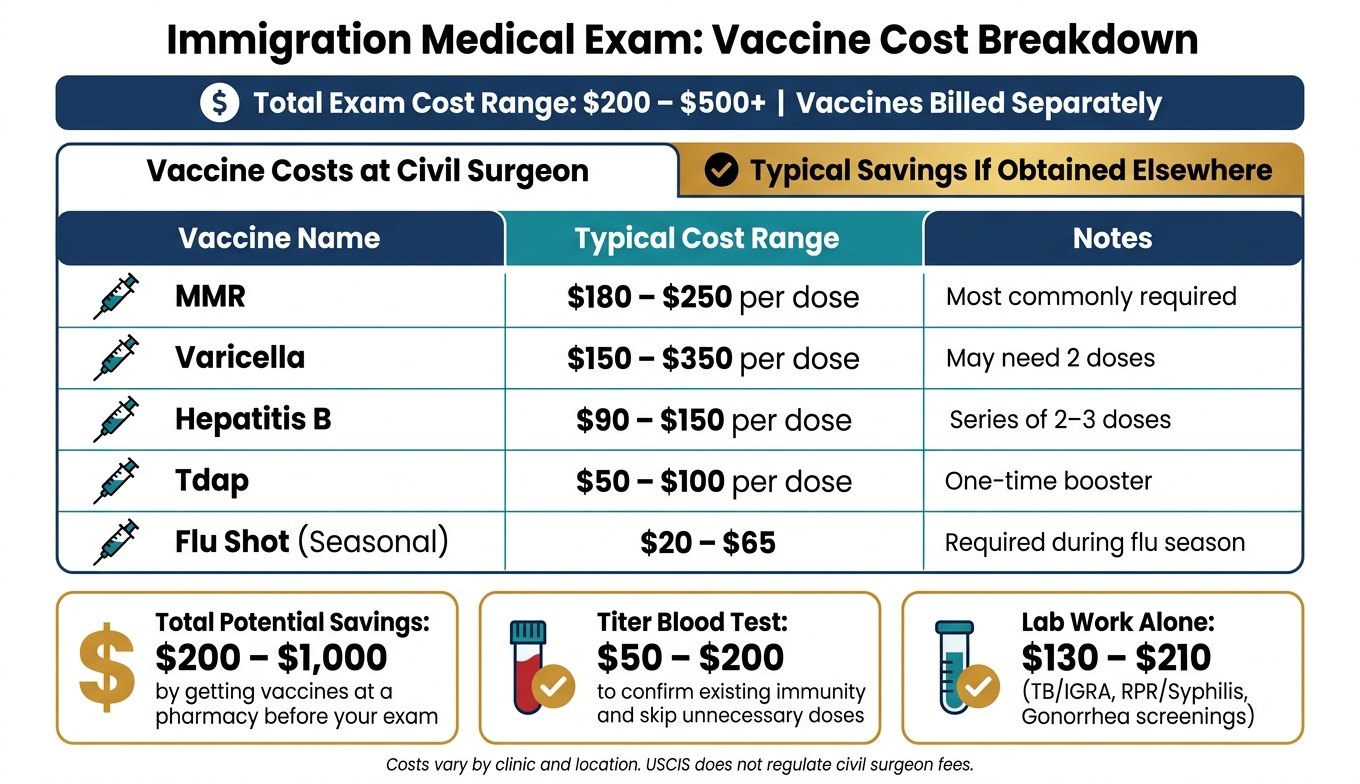
Immigration Medical Exam Vaccine Costs: Civil Surgeon vs. Pharmacy
After confirming your surgeon’s credentials, it’s essential to discuss the exam costs upfront to avoid unexpected expenses. Since USCIS doesn’t regulate civil surgeon fees, charges can vary significantly – even within the same city.
What Is the Total Cost, and What Does It Cover?
The immigration medical exam typically includes separate charges for the physical exam (required for Form I-693), lab tests (such as TB, RPR, and gonorrhea screenings), and any necessary vaccinations. Lab work alone – covering tests like the TB blood test (IGRA/Quantiferon Gold), syphilis (RPR), and gonorrhea screenings – can range from $130 to $210. There is no filing fee for Form I-693 itself; all payments go toward the medical services provided.
Some clinics offer an all-inclusive price, while others break down costs for each service. For instance, USCIS Immigration Medical Exam Specialists in Los Angeles charges $350 for standard service (7–9 days) and $475 for rush service (3–5 days). These packages cover the physical exam, I-693 completion, Quantiferon TB Gold, RPR/syphilis, and urine tests, but vaccines are billed separately. Other clinics may advertise a lower initial fee but add costs for individual tests or form processing, which can increase the total. Be sure to clarify all charges with your civil surgeon to avoid hidden fees.
Are Vaccines and Lab Tests Billed Separately?
Vaccines are often billed separately, even when clinics bundle lab tests into their base fees. The cost of vaccines can vary widely depending on the type:
| Vaccine | Typical Cost Range |
|---|---|
| MMR | $180 – $250 per dose |
| Varicella | $150 – $350 per dose |
| Hepatitis B | $90 – $150 per dose |
| Tdap | $50 – $100 per dose |
| Flu Shot (Seasonal) | $20 – $65 |
If you need several vaccines, the costs can add up quickly. To save money, consider getting required vaccinations at a pharmacy or community health clinic before your exam. Civil surgeons accept official immunization records, potentially saving you $200 to $1,000, depending on the number of doses needed. Additionally, if you believe you’re already immune to certain diseases, a titer blood test (costing $50–$200) can confirm immunity and help you avoid unnecessary vaccinations.
Understanding these costs can help you budget for the exam and avoid unexpected out-of-pocket expenses.
Does Health Insurance Cover Any Part of the Exam?
In most cases, health insurance won’t cover the exam itself.
"Many civil surgeons do not accept insurance; and insurance may not cover many portions of an immigration medical examination." – USCIS
The physical exam and Form I-693 completion are considered administrative requirements, not medically necessary care, which means most insurance plans won’t cover them. However, some insurance plans might cover preventive vaccinations or specific lab tests, such as TB or syphilis screenings. It’s worth checking with your provider before your appointment.
If your insurance does cover vaccines, you may be able to get them at your local pharmacy and then bring the records to your civil surgeon, reducing your out-of-pocket costs. Even if the clinic doesn’t bill insurance directly, ask for an itemized receipt. Lab tests, vaccines, and X-rays may qualify for reimbursement through a Flexible Spending Account (FSA) or Health Savings Account (HSA). Additionally, lower-income applicants should check whether any Federally Qualified Health Centers (FQHCs) in their area are USCIS-designated civil surgeons, as some offer sliding-scale fees based on income.
Preparing for the Exam and Knowing What to Expect
Once you’ve confirmed the costs, it’s time to dive into the details of the exam process – like how many visits you’ll need, what documents to prepare, and which tests or vaccines might be required.
How Many Visits Will I Need, and How Long Will It Take?
For most people, the process involves two visits. During the first visit, the civil surgeon will conduct a physical exam, review your medical history, and complete any necessary lab work. This appointment usually takes 1 to 2 hours. The second visit is for reviewing lab results and receiving your sealed Form I-693.
Why the second visit? Lab results, such as those for TB and syphilis screenings, typically take 24–72 hours. If a TB blood test comes back positive, a chest X-ray may be required. Additionally, you might need to return with updated vaccination records from another provider.
Plan ahead. Some clinics require appointments to be booked 2 to 4 weeks in advance. If you’re in a time crunch, ask if expedited services are available. For instance, USCIS Immigration Medical Exam Specialists in Los Angeles offers rush services with results in 3–5 days, compared to the standard 7–9 days.
Once you’ve figured out the timeline, make sure you’re ready with all the required documents.
What Documents Should I Bring to My Appointment?
To avoid delays, gather everything you need before your appointment. Here’s a quick checklist:
| Document | Notes |
|---|---|
| Photo ID | A passport is preferred, but a driver’s license is also accepted. |
| Vaccination Records | Must include the exact month, day, and year for each dose. Self-reported histories aren’t accepted. |
| Form I-693 | Use the 01/20/25 edition and complete Part 1. Don’t sign it until instructed. |
| Medical Records | Bring documentation for chronic conditions (e.g., diabetes, hypertension) or past TB/syphilis treatment. |
| I-94 Form | Required for applicants with refugee status. |
| Payment | Clinics typically accept credit, debit, or cash payments. |
If your records are in another language, make sure to provide a reliable English translation beforehand. After the exam, request a copy of your signed Form I-693 for your records and check it for accuracy before the original is sealed.
"Some doctors refuse to give a copy, but you are legally entitled to one. You need that copy to verify accuracy and keep it for your records." – John Khosravi, Immigration Attorney, JQK Law
Which Tests and Vaccines Will I Need Based on My Age and Medical History?
The required tests depend on your age and health history. For example:
- TB Blood Test (IGRA/QuantiFERON Gold): Required for everyone aged 2 and older. Starting March 11, 2024, the older TST skin test will no longer be accepted.
- Syphilis Blood Test: Mandatory for applicants aged 18 to under 45.
- Gonorrhea Urine Test (NAAT): Required for those aged 18 to 24.
Vaccination requirements are age-specific and usually include MMR, Varicella, Tdap, Hepatitis A and B, and the seasonal Influenza vaccine (during flu season). Missing records for vaccines like MMR or Hepatitis B? Ask about titer blood tests to confirm immunity. These tests cost $50–$75 per vaccine at USCIS Immigration Medical Exam Specialists, which can save you money compared to getting new doses.
If you have chronic conditions like diabetes or high blood pressure, bring updated documentation to show they are well-managed. These conditions are typically marked as Class B on Form I-693 and won’t make you inadmissible. Providing thorough records helps the civil surgeon complete your form correctly and minimizes the risk of follow-up requests.
Handling Medical Issues and Getting Your Results
Proper follow-up documentation is just as important as preparing for the exam itself. After your medical exam, certain factors could delay the completion of your Form I-693 or the delivery of your results.
What Happens If I Have a Positive TB Test or Missing Vaccine Records?
If your IGRA test for tuberculosis (TB) comes back positive, you’ll need a chest X-ray to determine whether the TB is active or latent. Here’s the key point: latent TB doesn’t make you inadmissible and won’t stop you from getting your green card as long as it’s properly documented. Active TB (classified as Class A), however, is a barrier to admission – but even that can be resolved with treatment.
"A positive TB skin test or blood test does not mean you are inadmissible – it means further evaluation is needed. The critical distinction is between latent TB (an infection that is not active or contagious) and active TB (a current, communicable disease)." – Oleg Gherasimov, Esq., Partner, SG Legal Group
Your Form I-693 cannot be signed or sealed by the civil surgeon until all TB-related follow-up steps are complete. If you’ve had a positive TB test in the past, plan for potential delays – referrals to public health departments can take weeks.
For missing vaccine records, ask your civil surgeon about titer blood tests to check for immunity before assuming you need additional doses. The form won’t be finalized until all vaccination requirements are met.
Now, let’s cover how to manage and submit your sealed Form I-693.
When and How Will I Receive My Completed I-693 Form?
Once your exam and documentation are complete, the civil surgeon will give you a sealed envelope with their signature across the seal. Do not open this envelope – if the seal is broken when USCIS receives it, the form will be rejected, and you’ll have to redo the entire exam.
What you do with the envelope depends on your filing method:
| Filing Method | Envelope Requirement | What to Do |
|---|---|---|
| Mail-in (Form I-485) | Must remain sealed | Submit the sealed envelope with your application. |
| Online (Form I-485) | Must be opened | Open the envelope, upload a scan, and keep the original for your interview. |
| Lockbox rejection | May be opened | Resubmit the opened form along with the USCIS rejection notice. |
It’s smart to ask for an unsealed personal copy of your Form I-693 before the envelope is sealed. Review it carefully with the civil surgeon to ensure there are no errors – fixing mistakes after sealing requires another trip to the clinic. Some clinics, like USCIS Immigration Medical Exam Specialists in Los Angeles, offer a second sealed copy at a reduced price if you order it at the same time.
How Long Is the I-693 Form Valid for USCIS Submission?
As of November 1, 2023, Form I-693 no longer expires if signed by a civil surgeon on or after that date. This eliminates much of the time pressure applicants previously faced.
Still, it’s best to schedule your medical exam close to your filing date. Health conditions can change, and USCIS might request an updated exam if too much time has passed or if there are changes in your health. If your priority date isn’t current yet, there’s no need to rush – but don’t leave it until the last minute either.
Conclusion: Steps to a Smooth Immigration Medical Exam
Taking the time to ask the right questions before and during your appointment can save you from unnecessary delays. Start by confirming that your surgeon is USCIS-designated. Then, make sure you understand the costs, gather all required documents, and plan for follow-ups related to TB tests or missing vaccines. These simple steps can make what might feel like a complicated process much more manageable.
Having your documents in order is equally important. For example, providing complete vaccination records can save you anywhere from $50 to $200 per missing vaccine series, ensuring the surgeon only administers what’s absolutely necessary.
Choosing an experienced, USCIS-designated civil surgeon can also make a big difference. Specialized clinics are often up-to-date on policy changes – like the December 2, 2024, requirement to file Form I-693 concurrently with Form I-485 – and they usually handle the paperwork correctly on the first try. If you’re in Los Angeles County, USCIS Immigration Medical Exam Specialists, founded by Dr. Asher Ram, offers both standard services ($350) and expedited rush options ($475), with results ready in as little as three days. They also provide on-site lab testing and flexible scheduling, making it easier for families to navigate the process.
FAQs
What should I do if I can’t find my vaccination records?
If you can’t find your vaccination records, don’t stress – this happens more often than you might think. During your visit, the civil surgeon can run blood tests (known as titers) to check your immunity. Alternatively, they can give you the necessary vaccines. For multi-dose vaccines, only the first dose is required to complete Form I-693. At their Los Angeles clinic, USCIS Immigration Medical Exam Specialists can help with vaccinations, simplifying the process for you.
Can I get required vaccines at a pharmacy before my I-693 exam?
Yes, you can receive the necessary vaccines at a pharmacy before your I-693 medical exam. Just make sure to bring valid, written proof of your vaccinations to your appointment. This allows the civil surgeon to verify the information and include it on your Form I-693. Alternatively, USCIS Immigration Medical Exam Specialists can review your vaccination records and provide any missing vaccines during your visit to ensure everything is completed properly.
What happens if my TB blood test is positive?
A positive TB blood test doesn’t prevent you from obtaining a green card. It simply shows that your immune system has been exposed to TB bacteria, commonly pointing to a latent TB infection (LTBI). This type of infection is inactive and not contagious.
If your test result is positive, the next step involves a chest X-ray and a clinical evaluation to ensure you don’t have active TB. In cases where active TB is detected, treatment must be completed before moving forward with the immigration process.
